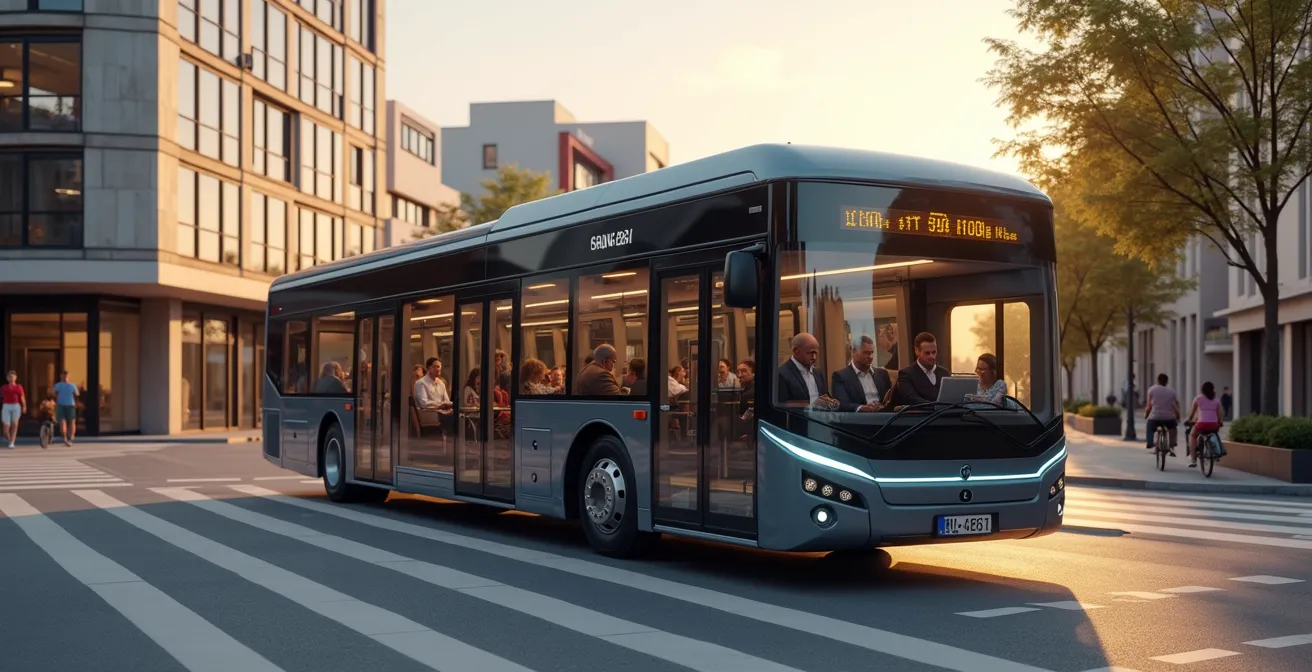
Contrary to popular belief, public acceptance of autonomous buses does not hinge on flawless technology, but on the successful management of human psychology.
- Building trust requires a proactive “Responsibility Framework” that clarifies liability before an incident occurs, not after.
- Empathetic in-cabin design that communicates the vehicle’s intent is more critical for passenger reassurance than displaying complex sensor data.
Recommendation: Transport authorities must shift their focus from purely engineering-led projects to sociological design problems, prioritizing the passenger’s perception of safety, control, and agency.
For transport authorities on the verge of deploying autonomous fleets, the central challenge is often framed as a technological one: perfecting sensor fusion, optimizing routes, and ensuring operational uptime. The prevailing wisdom suggests that a sufficiently safe and efficient system will inevitably win public favor. This perspective, however, overlooks the most unpredictable variable in the entire system: the human passenger. The empty driver’s seat is not just a technical feature; it is a powerful symbol that triggers deep-seated anxieties about control, responsibility, and vulnerability.
Simply presenting performance data and launching public education campaigns—the standard platitudes of AV deployment—are insufficient. They fail to address the core sociological issue. The public’s hesitation is not born of ignorance about LiDAR, but from a fundamental question: “Who is in control, and who is responsible when something goes wrong?” Building genuine, lasting trust requires a strategic pivot. It demands that we move beyond engineering and engage in a form of societal design.
But if the solution isn’t just better technology, what is it? The key lies in preemptively designing the entire passenger experience around the principles of agency and legibility. It’s about making the vehicle’s “intent” understandable to a non-expert, creating clear frameworks for accountability, and proving system maturity through transparent, methodical milestones. This article provides a strategic framework for transport authorities, examining the critical pillars of liability, passenger experience, security, and deployment strategy needed to transform public apprehension into widespread adoption.
Summary: From Apprehension to Adoption: A Strategic Framework for Gaining Public Trust in Autonomous Buses
- Who Is Responsible When an Autonomous Bus Crashes: The Coder or the Operator?
- How to Design In-Cabin Screens That Reassure Passengers There Is No Driver?
- Wheelchair Access in Driverless Shuttles: How to Automate Assistance?
- The Hijack Risk: Preventing Hackers from Rerouting Autonomous Fleets
- When to Move from Closed Loops to Open Traffic: The Safety Milestones?
- Autonomous Transport vs Hyperloop: Which Solves Congestion Faster?
- The risk of “Automation Bias”: When Humans Stop Checking AI Outputs
- Managing Autonomous EV Fleets: How to Solve the “Last Mile” Delivery Puzzle?
Who Is Responsible When an Autonomous Bus Crashes: The Coder or the Operator?
The question of liability is the single greatest barrier to public trust. Before a single passenger boards, transport authorities must have a clear and public-facing answer. The ambiguity of “the system failed” is unacceptable. In the event of an incident, the public will not distinguish between a software bug and an operational error; they will see a failure of the entire service. The sobering reality is that accidents will happen; a recent analysis documents nearly 4,000 autonomous vehicle incidents since 2019, some fatal. This makes a proactive liability structure non-negotiable.
The legal precedent is slowly forming around a “product liability” theory, which shifts focus onto the vehicle’s entire supply chain. This means an injured party could potentially hold the manufacturer responsible for design defects (like sensor placement), the software developer for coding flaws, or the operator for inadequate safety protocols and warnings. This creates a complex web of shared responsibility that must be untangled contractually before deployment, not litigated reactively in court.
Therefore, the strategic imperative for public transport authorities is to establish a multi-tiered liability framework. This involves creating clear agreements with manufacturers, software providers, and insurers that delineate responsibility for different types of failures. This framework should be transparent and communicable to the public in simplified terms. It’s not about finding someone to blame, but about demonstrating that a robust system of accountability exists. This act of preemptive governance is a powerful tool for building foundational trust, showing that the operator has considered the worst-case scenarios and has a plan in place.
How to Design In-Cabin Screens That Reassure Passengers There Is No Driver?
With no driver to ask “What was that noise?” or “Are we taking a detour?”, the in-cabin environment becomes the primary communication channel. This is where passenger anxiety is either calmed or amplified. Given that a 2022 Pew Research poll found that 44% of Americans hold a negative view of autonomous vehicles, the design of these interfaces is a critical trust-building exercise. The goal is not to overwhelm passengers with raw data from LiDAR or sensor arrays, but to provide what sociologists call “legibility of intent.” Passengers need to understand what the bus is “thinking” and “seeing” in simple, human terms.
Effective reassurance interfaces are built on a few key principles. They must use simple, universally understood language to describe the vehicle’s status and actions. They must be clear about both the capabilities and, crucially, the limitations of the technology. Rather than complex schematics, designs should focus on ambient communication—subtle shifts in lighting color to indicate braking, or a calm chime to confirm an upcoming stop. The interface should feel like a helpful concierge, not a complex engineering diagnostic tool.
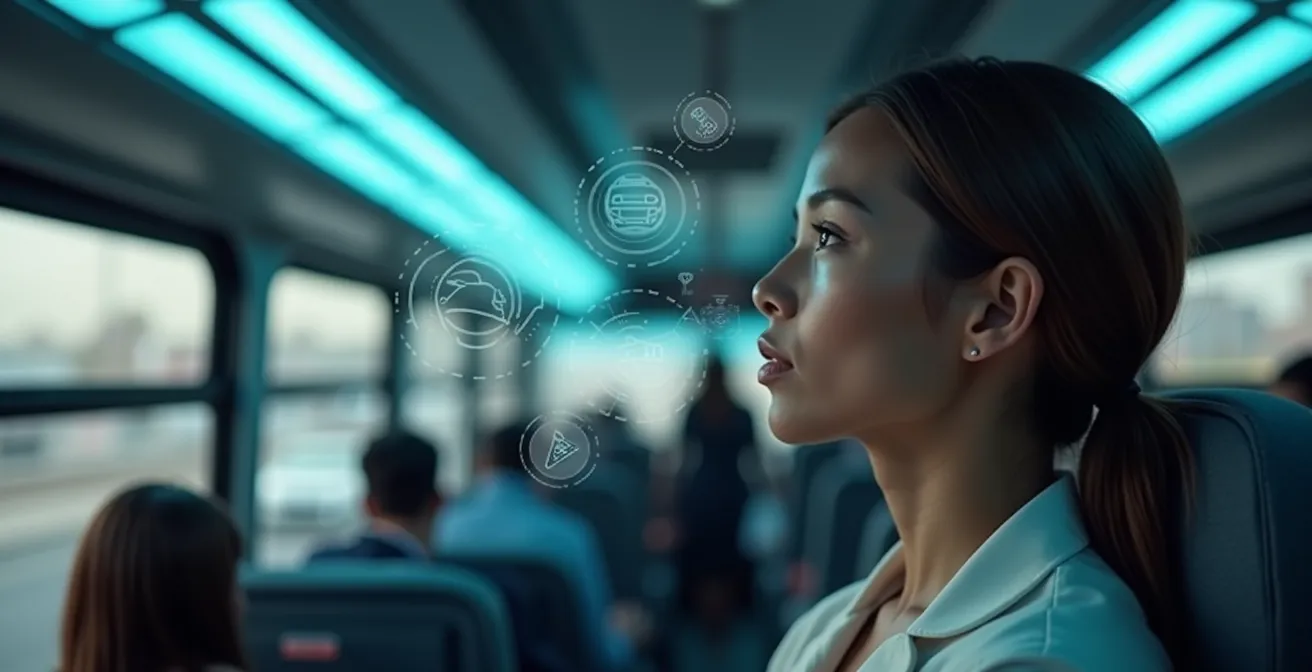
As seen in the conceptual design above, the focus is on a calm, human-centric experience. A transparent route display might show the path ahead, with abstract patterns indicating that the bus has detected pedestrians and is adjusting its course accordingly. This visual confirmation gives passengers a sense of vicarious agency and control. They can see that the system is aware and responsive, which mitigates the feeling of helplessness that comes from being in a vehicle with no visible pilot. The screen’s purpose is to build an emotional connection based on perceived competence, not to provide a technical lecture.
Wheelchair Access in Driverless Shuttles: How to Automate Assistance?
For autonomous public transport to be a true public good, it must be accessible to everyone from day one. Automated accessibility is not a feature to be added later; it is a core test of the system’s social viability. While technologies like automated ramps and wheelchair lifts are becoming standard, a truly inclusive system requires thinking beyond the vehicle itself. It demands a holistic approach to the entire journey for passengers with mobility challenges.
The challenge is automating not just the mechanics of a ramp, but the human assistance that often accompanies it. How does a passenger signal the need for the ramp? How is the vehicle’s position at the curb guaranteed to be precise enough for safe deployment? How does the system communicate with the passenger to confirm they are safely aboard before departing? This requires a combination of intuitive user interfaces inside and outside the vehicle, high-precision docking capabilities, and robust sensor systems to ensure the ramp area is clear.
A study in the journal *Discover Sustainability* highlights the need for a systemic view. Researchers emphasize that true accessibility depends on a wider infrastructure, as they note:
Infrastructure requirements should include accessible technology for diverse social groups, pick-up point accessibility, designated pick-up locations, road infrastructure, signs, telecommunications networks and other supporting facilities.
– Researchers, Discover Sustainability journal
For transport authorities, this means the work begins at the curb. It involves designing accessible pick-up points, integrating communication systems via a passenger’s mobile device, and ensuring the entire process is seamless and dignified. Inclusive automation is a powerful demonstrator of a service’s commitment to its community, building trust with all passengers by proving it serves the most vulnerable.
The Hijack Risk: Preventing Hackers from Rerouting Autonomous Fleets
While physical safety is the most visible concern for passengers, the invisible threat of a cyberattack is a potent and growing source of public anxiety. The prospect of a hacker rerouting a bus, causing a deliberate crash, or disabling an entire fleet is no longer science fiction. For transport authorities, securing an autonomous fleet is as critical as maintaining its brakes and tires. Public trust is contingent on the belief that the system is not only safe from error but also secure from malice.
The attack surface for an autonomous vehicle is vast. Cybersecurity research identifies several major threats, including the remote hacking of vehicle controls, the manipulation of sensor data (e.g., “spoofing” a GPS signal or creating phantom obstacles), data breaches of passenger information, and Denial-of-Service (DoS) attacks that could paralyze the fleet. A robust security strategy must therefore be multi-layered, encompassing everything from the individual vehicle’s hardware to the central fleet management network.

A state-of-the-art approach involves building a “digital twin” of the fleet—a virtual replica that runs in parallel to the real-world operation. This allows security teams to monitor network traffic in real-time, run attack simulations, and identify anomalies before they can affect physical vehicles. The use of end-to-end encryption for all communications, from the vehicle to the control center (V2X), is fundamental. By investing visibly in a dedicated security operations center, authorities can demonstrate that cybersecurity is not an afterthought but an active, 24/7 component of fleet management, reassuring the public that digital guardians are always on watch.
When to Move from Closed Loops to Open Traffic: The Safety Milestones?
The path to full autonomy is not a single leap but a series of carefully managed steps. The most critical transition is from a controlled, “closed-loop” environment (like a corporate campus or a dedicated bus lane) to the chaotic, unpredictable world of open, mixed traffic. This move cannot be dictated by a calendar date; it must be earned through the achievement of specific safety and social milestones. Rushing this step could irreparably damage public trust.
Technically, the milestones include demonstrating a certain number of miles driven without a safety-critical disengagement, proving the system’s competence in handling a wide range of “edge cases” (e.g., erratic drivers, unusual weather), and validating the reliability of its sensor and communication systems. However, the social milestones are equally important. Research from Springer suggests a key benchmark is achieving a minimum public acceptance rating of over 75% from residents in the proposed deployment area. This metric forces authorities to prove they have earned the community’s confidence before expanding.
A successful pilot program, like the driverless bus trial at Milton Park in the UK which saw 1,400 people participate, serves as a crucial data-gathering and trust-building exercise. These trials allow the public to experience the technology in a low-risk setting while providing operators with invaluable data on both system performance and passenger sentiment. A phased approach is key: start with a simple, predictable route, gather data, demonstrate success, and only then expand the Operational Design Domain (ODD). This methodical, transparent progression shows the public that the authority is prioritizing safety over speed.
Action Plan: Validating Open-Road Readiness
- Technical Performance Audit: Collate all performance data from closed-loop trials, including miles-per-disengagement, performance in adverse weather, and successful navigation of identified edge cases.
- Public Sentiment Survey: Commission an independent survey of residents and businesses along the proposed open-traffic route to measure acceptance and identify key concerns, targeting a >75% approval rating.
- Regulatory Compliance Checklist: Verify that the proposed service complies with all local, regional, and national transport regulations for Level 4 autonomous operation, securing all necessary permits.
- First Responder Training: Conduct comprehensive training sessions with local police, fire, and medical services, ensuring they understand how to interact with and manually control the vehicles in an emergency.
- Communication Plan Finalization: Prepare a public communication plan that clearly outlines the new route, the safety milestones achieved, the limitations of the service, and the established liability framework.
Autonomous Transport vs Hyperloop: Which Solves Congestion Faster?
When discussing future urban mobility, two technologies often dominate the conversation: autonomous vehicle fleets and the Hyperloop. While both promise to revolutionize transport, they operate on vastly different timelines and solve fundamentally different problems. For a transport authority looking to alleviate urban congestion in the near term, the choice is clear. Hyperloop is a long-term vision for inter-city travel, requiring massive infrastructure investment and decades of development. Autonomous buses, by contrast, offer an immediate, flexible solution for intra-city transit.
The key advantage of autonomous buses is their ability to leverage existing infrastructure. They do not require the construction of expensive new tunnels or tracks. They can be deployed on current roads, with their routes dynamically adjusted to meet changing demand. This inherent flexibility makes them a far more agile tool for tackling the “first mile, last mile” problem and improving the efficiency of the current public transport network. The initial investment is focused on the fleet itself, not a multi-billion dollar civil engineering project.
This table compares the two technologies on key deployment factors, highlighting the pragmatic advantages of autonomous buses for solving near-term urban challenges.
| Factor | Autonomous Buses | Hyperloop |
|---|---|---|
| Infrastructure Required | Existing roads | New dedicated tracks |
| Deployment Timeline | Months to years | Decades |
| Flexibility | Dynamic rerouting possible | Fixed track system |
| Initial Investment | Fleet purchase only | Massive infrastructure build |
The market reflects this reality. While Hyperloop remains largely conceptual, the autonomous bus market is poised for significant growth. Projections indicate it could reach USD 12.4 billion by 2034. This demonstrates strong industry confidence in the technology’s viability and its role in the immediate future of public transport. For authorities, autonomous buses are not a distant dream; they are a practical, scalable solution available today.
The risk of “Automation Bias”: When Humans Stop Checking AI Outputs
While much of the focus is on building enough trust for people to use autonomous buses, there is a paradoxical risk at the other end of the spectrum: over-trust. Known as “automation bias” or “automation complacency,” this is the tendency for humans to over-rely on an automated system, becoming less vigilant and failing to check its outputs. For autonomous bus fleets, this poses a significant risk not for passengers, but for the human supervisors in the remote command center.
As a system proves itself to be reliable 99.9% of the time, the human operator tasked with monitoring the fleet can become disengaged. They may start to assume the system will always make the right decision, leading them to miss the rare but critical 0.1% of instances where human intervention is required. Imagine a remote operator overseeing twenty buses. If for hours on end every bus navigates flawlessly, the operator’s attention may drift, causing them to miss a subtle alert indicating a sensor failure on one of the vehicles. This is precisely when an accident can occur.
This psychological phenomenon is critical because research demonstrates that trust is the strongest factor leading to the intention to use autonomous buses. While this is positive for passenger adoption, it’s a warning signal for operational design. Mitigating automation bias requires a strategic approach to designing the role of the human supervisor. Their job should not be passive monitoring. Instead, they should be engaged in proactive tasks: running diagnostics, optimizing routes, and handling complex customer service interactions relayed from the buses. The system should require periodic, meaningful engagement to keep the operator’s cognitive faculties sharp and ready to intervene effectively when needed.
Key Takeaways
- Public trust is a sociological challenge, not a technological one; it must be designed, not just marketed.
- A proactive, transparent liability framework is more crucial for building trust than advertising a vehicle’s technical specifications.
- In-cabin interfaces must provide “legibility of intent” to give passengers a sense of agency and control, reducing anxiety.
Managing Autonomous EV Fleets: How to Solve the “Last Mile” Delivery Puzzle?
The ultimate vision for autonomous EV fleets extends beyond just moving people. It’s about creating a highly efficient, multi-purpose urban logistics network. The solution to the notoriously difficult and expensive “last mile” puzzle—getting people and goods to their final destinations—lies in intelligent fleet management that maximizes vehicle uptime and utility. This is made even more critical by a growing operational challenge: an estimated 14% worldwide shortage of professional drivers.
The strategic answer lies in a dual-use fleet model. During peak commuter hours, the fleet operates as a public transport system. During off-peak hours—midday, late at night—the same vehicles can be repurposed for package delivery, mail transport, or even municipal services like waste sensor monitoring. This approach dramatically increases the return on investment for each vehicle and turns a fixed-cost asset into a dynamic revenue-generating platform. A small, agile pod might serve as a passenger shuttle in the morning and a delivery bot in the afternoon.

This integrated network, where autonomous buses and shuttles operate seamlessly alongside traditional transit and delivery systems, is the end-game. However, this level of complex fleet orchestration is only possible if the foundational public trust has been firmly established. No city will permit a fleet of autonomous vehicles to operate 24/7, switching between carrying people and parcels, if the public does not have absolute confidence in its safety, security, and accountability. Every step discussed—from liability frameworks to in-cabin design—is a prerequisite for unlocking this final, powerful phase of autonomous urban mobility.
By shifting the focus from a purely technical race to a human-centric design challenge, transport authorities can build the deep, lasting trust necessary to not only launch autonomous bus services but to make them an integral and valued part of the urban fabric. The next step is to begin architecting your own public trust framework today.