
In high-frequency finance, real-time decision-making is not about being ‘fast’—it’s a war against physics where architecting for failure is the only viable strategy.
- The value of trading data decays exponentially; a few milliseconds of lag can erase millions in potential profit and create catastrophic risk.
- Resilient systems are not built to prevent failure but to handle it gracefully through intelligent load shedding, backpressure, and tiered architecture.
Recommendation: Shift focus from chasing zero latency to engineering robust, failure-tolerant data pipelines that deliver deterministic performance under extreme stress.
In the world of finance, ‘real-time’ is a dangerous illusion. While most industries celebrate second-long response times, high-frequency trading (HFT) operates on a battlefield where a single millisecond is an eternity. The competitive edge isn’t just about processing data quickly; it’s about engineering systems with a profound understanding of hardware limitations, network physics, and the inevitability of failure. Forget the generic advice about ‘leveraging big data.’ The real challenge is a brutal, zero-sum game of microseconds.
The common approach is to throw more hardware at the problem, hoping to brute-force speed. This is a losing strategy. The true masters of this domain—the CTOs and quants who consistently win—think differently. They embrace a philosophy of “mechanical sympathy,” designing software that works in harmony with the physical constraints of their infrastructure. They don’t just build pipelines; they construct complex, self-healing organisms designed to withstand the chaotic surges of market data without crashing.
This isn’t a theoretical exercise. It’s about mitigating the risk of a “desynchronized reality,” where decisions are made on a flawed mosaic of fresh and stale data. The solution lies in a holistic architectural approach, from the physical proximity of servers to the matching engine, to the algorithmic sophistication of your data cleaning protocols. It’s about moving from simple, reactive rules to predictive neural networks that can anticipate market regimes before they fully materialize.
This guide dissects the architectural principles and trade-offs required to build a true real-time decision engine. We will move beyond the platitudes to provide a technologist’s blueprint for winning the latency war, where victory is measured not in seconds, but in the microseconds that separate profit from catastrophic loss.
This article provides a technical deep-dive into the critical components of a high-performance data processing architecture. The following sections will guide you through the core challenges and solutions, from quantifying the cost of delay to implementing advanced data-cleaning protocols.
Summary: How Automated Big Data Processing Enables Real-Time Decision Making in Finance
- Why a 1-Second Delay in Data Processing Can Cost Millions in Trading?
- How to Build a Streaming Pipeline That Handles Spikes Without Crashing?
- Apache Kafka vs Spark Streaming: Which Handles High Throughput Better?
- The Data Lag Risk: Making Decisions on “Live” Data That Is Actually 5 Minutes Old
- How to Tier Storage So Hot Data Remains Instantly Accessible?
- Why High-Frequency Trading Firms Can’t Rely on Public Cloud Regions?
- Why Simple Algorithms Fail Where Neural Networks Succeed?
- How to Clean Industrial Datasets to Prevent Algorithm Errors?
Why a 1-Second Delay in Data Processing Can Cost Millions in Trading?
In high-frequency trading, a one-second delay isn’t a performance issue; it’s a complete system failure. The value of market data decays exponentially with time, a concept known as data-value decay. An opportunity that exists at microsecond zero is often gone by microsecond 500. This isn’t hyperbole; it’s the fundamental physics of the market. For elite trading firms, a 1 millisecond advantage can be worth over $100 million per year in execution improvements alone. When your competitors operate on a sub-millisecond latency budget, a one-second lag means you are effectively trading on historical data, guaranteeing losses.
This financial impact is driven by latency arbitrage, where algorithms exploit microscopic price discrepancies across different exchanges. A landmark study from Oxford’s Quarterly Journal of Economics revealed that these “races,” often lasting mere microseconds, are not a niche activity. The research found that 22% of all FTSE 100 trading volume occurs in latency arbitrage races. A delay of even a few milliseconds means you consistently arrive last, becoming the liquidity that winners prey on. The cost isn’t just the missed opportunity; it’s the guaranteed loss from executing a trade based on a reality that no longer exists.
The damage cascades through the system. A delay in the pricing engine feeds stale data to the risk management module, which in turn reports an inaccurate risk profile to the compliance system. This creates a chain reaction of flawed decisions, where every subsequent calculation is built on a rotten foundation. Quantifying this cost requires rigorous measurement, including implementing watermarking in data streams to track latency at each stage and mapping the cascade failure risks across dependent systems. In this environment, latency is not a metric; it is the primary measure of operational viability.
How to Build a Streaming Pipeline That Handles Spikes Without Crashing?
Building a streaming pipeline for finance is not about achieving the highest possible throughput in a lab environment; it’s about engineering for survival during market-open or news-driven data tsunamis. A pipeline that performs flawlessly at 100,000 messages per second is useless if it collapses at 100,001. The core principle is to architect for failure, not to prevent it. This means implementing strategies that gracefully degrade performance or shed load rather than allowing a single component failure to trigger a catastrophic system-wide crash.
The primary mechanisms for handling unexpected spikes are buffering, load shedding, elastic scaling, and circuit breakers. Each comes with a critical trade-off between latency, data loss, and cost. For non-critical streams like end-of-day reporting, buffering data is acceptable. But for real-time pricing, where every microsecond counts, introducing a 500ms buffer is a death sentence. In these scenarios, load shedding—intentionally dropping less critical messages to preserve the core function—is often the superior, albeit ruthless, strategy. This requires a sophisticated understanding of which data can be sacrificed without compromising the integrity of the trading model.

As the architecture above suggests, modern pipelines rely on load balancers and redundant pathways to manage flow. Elastic scaling, or automatically adding more processing nodes, is a viable strategy for predictable spikes (like market open), but it’s often too slow to react to flash events, introducing unacceptable latency as new instances spin up. A circuit breaker pattern, which automatically halts requests to a failing service, offers the fastest protection but can result in data loss if not paired with a persistent queue. The choice of strategy is not a one-size-fits-all decision; it must be tailored to the specific latency budget and data loss tolerance of each microservice in the pipeline.
The following table, based on common industry models, breaks down the trade-offs of these spike-handling strategies. As a comparative analysis of real-time processing shows, there is no single best solution, only the best fit for a specific use case.
| Strategy | Latency Impact | Data Loss Risk | Cost | Best For |
|---|---|---|---|---|
| Buffering | High (+100-500ms) | Low | Medium | Non-critical streams |
| Load Shedding | Low (+10ms) | High | Low | Real-time pricing |
| Elastic Scaling | Medium (+50ms) | Low | High | Predictable spikes |
| Circuit Breaker | Very Low (+5ms) | Medium | Low | System protection |
Apache Kafka vs Spark Streaming: Which Handles High Throughput Better?
Comparing Apache Kafka and Spark Streaming is a category error often made by those new to high-performance data architecture. They are not direct competitors; they are complementary tools designed to solve different parts of the streaming problem. Kafka is the undisputed champion of high-throughput data ingestion. It is a distributed, persistent log—a “central nervous system” for data—designed to absorb massive, spiky data streams from multiple sources without breaking a sweat and guarantee message ordering within a partition.
Spark Streaming, on the other hand, operates on a micro-batching paradigm. It ingests data from sources like Kafka, groups it into small batches (e.g., every 500ms), and then processes those batches using the powerful Spark engine. While highly scalable for complex analytics and ETL-like transformations, this micro-batching nature introduces inherent latency. It’s an excellent tool for near-real-time analytics, but for true low-latency HFT applications where a 500ms delay is unacceptable, it is often too slow. The conversation has largely shifted towards true stream processors like Apache Flink.
As technologist Geoffrey Moore’s observation in a financial market data analysis project on GitHub highlights, the modern stack leverages the strengths of multiple tools:
Kafka serves as the persistent, high-throughput ‘central nervous system’ for data ingestion, while Apache Flink is used for ultra-low-latency stateful computations
– Geoffrey Moore, GitHub – Financial Market Data Analysis Project
Apache Flink processes data event-by-event, enabling stateful computations (like windowed aggregations) with latencies in the low milliseconds. The optimal architecture, therefore, is not an “either/or” choice. It’s using Kafka as the durable, high-throughput message bus and Flink (or a custom C++/FPGA solution for sub-microsecond needs) as the processing engine. This combination provides both resilience and extreme performance, allowing systems to handle throughputs that can exceed 100,000 transactions per second while maintaining minimal latency. Optimizing this stack requires deep JVM tuning, such as configuring off-heap memory and tuning the G1GC garbage collector to keep pauses below 10ms.
The Data Lag Risk: Making Decisions on “Live” Data That Is Actually 5 Minutes Old
One of the most insidious risks in financial data processing is “desynchronized reality.” This occurs when a decision-making algorithm is fed a mix of data with different levels of freshness. An algorithm might receive a real-time price tick (microseconds old) but combine it with market sentiment data that is five minutes old or a risk profile that was calculated 30 seconds ago. The system believes it is operating on “live” data, but in reality, it is making decisions based on a corrupted, time-warped view of the market. This is the digital equivalent of driving a car by looking in the rearview mirror.
The consequences are severe, ranging from missed arbitrage opportunities to executing catastrophic trades based on outdated risk assessments. In the HFT world, where peak algorithmic trading activity occurs at 10-30 milliseconds after a market event, a five-minute-old data point is not just stale; it’s poison. It contaminates the entire decision-making process, rendering even the most sophisticated algorithms useless. The core challenge is ensuring that all data inputs to a trading model are time-synchronized within a strict, predefined latency budget.
Mitigating this risk requires a disciplined architectural approach. Watermarking data streams with high-precision timestamps at the point of creation is the first step. This allows the processing engine to measure and enforce data freshness, discarding or quarantining any data that falls outside the acceptable latency window. It also requires a clear separation of data pipelines based on their freshness requirements. For example, a real-time pricing model should never be allowed to directly query a data lake containing historical or batch-processed data.
Case Study: Alibaba’s Real-Time Fraud Detection
To combat this desynchronization risk, Alibaba built a fraud risk monitoring system that uses real-time big data processing to analyze user behaviors instantly. By processing vast amounts of behavioral data with machine learning, the system identifies and blocks fraudulent transactions within milliseconds. This prevents losses that would occur if the fraud detection algorithm were using stale user behavior data mixed with fresh transaction requests, providing a powerful example of how to defeat “desynchronized reality” at scale.
How to Tier Storage So Hot Data Remains Instantly Accessible?
Not all data is created equal, especially in finance. The data needed to evaluate a trading position right now is infinitely more valuable than the data from last week’s trades. A flat storage architecture, where all data resides on the same type of media, is inefficient and dangerous. It either makes critical data too slow to access (if stored on HDDs) or makes storing historical data prohibitively expensive (if everything is on NVMe SSDs). The solution is a tiered storage architecture that aligns data access latency and cost with its business value.
This architecture categorizes data into “tiers” based on its access frequency and latency requirements. At the top is Tier 0: in-memory data. This is for the most critical information—current positions, live order books, and critical risk parameters—that must be accessible in nanoseconds or low microseconds. Technologies like Hazelcast or custom in-memory databases are used here, where data resides directly in RAM, bypassing the network and storage stack entirely.
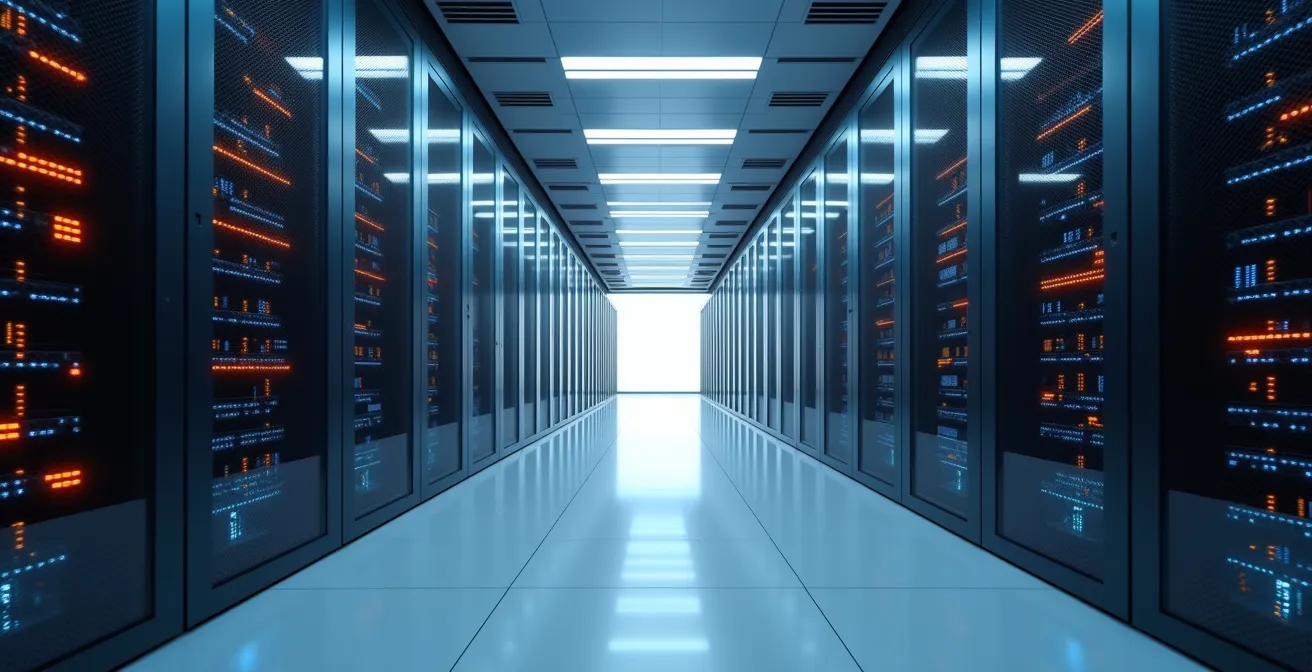
Just below this is Tier 1, consisting of NVMe SSDs. This tier holds “hot” data for the current trading day, such as tick-by-tick market data that needs to be accessed with latencies in the 10-100 microsecond range for back-testing or intra-day model recalibration. Tier 2, often using slower SAS SSDs, holds “warm” data from the past week, used for less frequent analysis. Finally, Tier 3 uses cheap, high-capacity storage like HDDs or cloud object storage (S3) for “cold” data—the vast archives of historical information required for regulatory compliance and long-term model training, where access times of seconds or even minutes are acceptable.
The table below outlines a typical tiered storage model in a high-performance financial environment. The key is to automate the data lifecycle, ensuring that data seamlessly and automatically “cools down,” moving to progressively slower and cheaper tiers as its immediate value diminishes.
| Tier | Technology | Latency | Cost/TB | Use Case |
|---|---|---|---|---|
| Tier 0 | In-Memory (Hazelcast) | <1μs | $5000 | Critical position data |
| Tier 1 | NVMe SSD | 10-100μs | $200 | Today’s trading data |
| Tier 2 | SAS SSD | 100μs-1ms | $50 | Week’s historical data |
| Tier 3 | HDD/S3 | >10ms | $20 | Compliance archives |
Why High-Frequency Trading Firms Can’t Rely on Public Cloud Regions?
For high-frequency trading, relying on a public cloud region for core trading operations is a non-starter. The reason is simple and brutal: physics. The speed of light imposes a hard limit on how quickly data can travel. Public cloud data centers are, by design, general-purpose facilities located for reasons of real estate cost, power availability, and regional demand—not for their proximity to the New York Stock Exchange’s matching engine. The round-trip latency from a standard AWS or Azure region to an exchange can be tens of milliseconds, an eternity in a world where the competition operates with an average latency under 1 millisecond for co-located systems.
Furthermore, public clouds are shared, multi-tenant environments. This introduces unpredictable latency, known as “jitter.” You have no control over the “noisy neighbors” on the same physical hardware or network fabric, who can cause random, intermittent spikes in your application’s latency. For an HFT algorithm that requires deterministic, predictable performance, this level of variability is unacceptable. You cannot build a winning strategy on a foundation of “maybe.”
This is why the entire HFT industry is built around co-location. Firms pay premium prices to place their servers in the same physical data center as the exchange’s matching engine. This reduces the physical distance data must travel to a few dozen meters of fiber optic cable, cutting latency to the sub-millisecond level that is physically impossible to achieve from a public cloud region. The exchanges themselves heavily monetize this physical proximity advantage.
Case Study: The Co-Location Advantage at NYSE
A hedge fund that co-locates its servers at the NYSE’s Mahwah data center in New Jersey can achieve sub-millisecond latency directly to the exchange’s matching engine. They pay a premium for this rack space. In contrast, even a well-funded institutional trader operating out of a nearby office building faces latencies of 10-100ms due to the public internet infrastructure. This difference in physical location creates a permanent, structural advantage for co-located firms, giving them deterministic execution that is simply unattainable in the public cloud. Data centers like Equinix NY4 (in Secaucus, NJ) have become the epicenter of this financial ecosystem precisely because of their proximity to multiple exchange matching engines.
Why Simple Algorithms Fail Where Neural Networks Succeed?
Simple, rule-based algorithms have been the bedrock of trading for decades. A typical algorithm might be: “If Moving Average A crosses above Moving Average B, and RSI is below 30, then buy.” These models are transparent, fast to execute, and effective in stable, predictable market conditions. However, their critical weakness is their rigidity. They fail spectacularly when market dynamics shift, as they are incapable of identifying the complex, non-linear patterns that characterize a change in market regime—such as a shift from a low-volatility “risk-on” environment to a high-volatility “risk-off” panic.
This is where neural networks (NNs) provide a decisive advantage. Unlike their rule-based counterparts, NNs are designed to learn and adapt from vast amounts of data. They excel at identifying subtle, high-dimensional correlations that are invisible to the human eye or a simple statistical model. For example, a neural network can learn how changes in bond yields, currency fluctuations, and options volatility collectively signal an impending market shift, a feat far beyond the scope of a simple moving average crossover.
The key is using the right architecture for the job. Specifically for financial time-series data, advanced architectures are required:
- Recurrent Neural Networks (LSTMs/GRUs): These are explicitly designed to model sequential data, allowing them to understand the temporal context of market events and detect regime shifts over time.
- Attention Mechanisms: These can be added to LSTMs to allow the model to focus on the most critical historical data points when making a prediction, ignoring irrelevant noise.
- Convolutional Neural Networks (CNNs): While typically used for images, time-series data can be converted into image-like formats (like Gramian Angular Fields), allowing CNNs to excel at raw pattern recognition within price action.
By combining these architectures into ensemble models, firms can build predictive systems that are far more robust and adaptive than simple, static algorithms. These models don’t just react to the market; they learn its changing personality, providing a crucial edge in navigating the complex and ever-shifting financial landscape. Of course, this power comes with the absolute necessity of validating these complex models on vast amounts of out-of-sample data spanning many different historical market conditions to avoid overfitting.
Key Takeaways
- Winning in HFT is an engineering battle against physics and system failure, not just a race for speed.
- Data-value decay is exponential; a microsecond delay has a quantifiable, and often massive, financial cost.
- Resilient pipelines are architected to handle failure through intelligent load shedding and backpressure, not to prevent it.
How to Clean Industrial Datasets to Prevent Algorithm Errors?
A sophisticated trading algorithm fed with dirty data will produce nothing but sophisticated garbage. In the context of industrial-scale financial datasets, “dirty data” can take many forms: bad ticks from a faulty exchange feed, out-of-sequence data packets due to network latency, or contaminated price feeds from dark pool prints. These errors, if not meticulously filtered in real-time, can trick an algorithm into seeing false patterns, leading to flawed trades and significant losses. Data cleaning is not a one-time, offline task; it is an active, continuous, and mission-critical part of the live trading pipeline.
The protocol for cleaning data must be as fast and robust as the trading algorithm itself. This involves a multi-layered defense. The first layer is often statistical, using sliding window outlier detection to identify and discard “bad ticks”—price points that are statistically impossible, like a stock momentarily trading at $0.01. The next layer must address out-of-sequence data, a common problem in distributed systems. Using timestamp ordering buffers, the system can hold packets for a few microseconds to reassemble them into the correct chronological order before they are fed to the trading logic.
Furthermore, an effective cleaning protocol must be aware of the data’s source. For example, prints from dark pools (private exchanges) can occur at prices significantly different from the public market and can contaminate a consolidated price feed if not properly filtered or flagged. Ultimately, this process of managing data quality is an ongoing battle against “data debt”—the accumulation of small imperfections that eventually corrupt the entire system. This requires both real-time streaming filters and asynchronous quality checks that refactor and improve data hygiene over time.
Action Plan: A Real-Time Data Cleaning Protocol
- Implement sliding window outlier detection for bad tick filtering.
- Correct out-of-sequence packets using timestamp ordering buffers.
- Filter dark pool prints that can contaminate public price feeds.
- Apply statistical methods (e.g., Z-score) to detect and quarantine anomalous data streams.
- Measure and refactor “data debt” through asynchronous data quality checks.
Ultimately, achieving true real-time decision-making is the culmination of these interconnected disciplines. It requires a relentless focus on performance, a deep respect for the physical limitations of hardware, and an architectural philosophy that embraces failure as an inevitability to be managed, not an anomaly to be avoided. For organizations looking to compete at the highest level, the next step is to conduct a full-scale audit of their existing data pipelines, from ingestion to execution, to identify and eliminate every source of unnecessary latency. Begin today to implement these strategies and transform your data processing from a liability into a decisive competitive weapon.