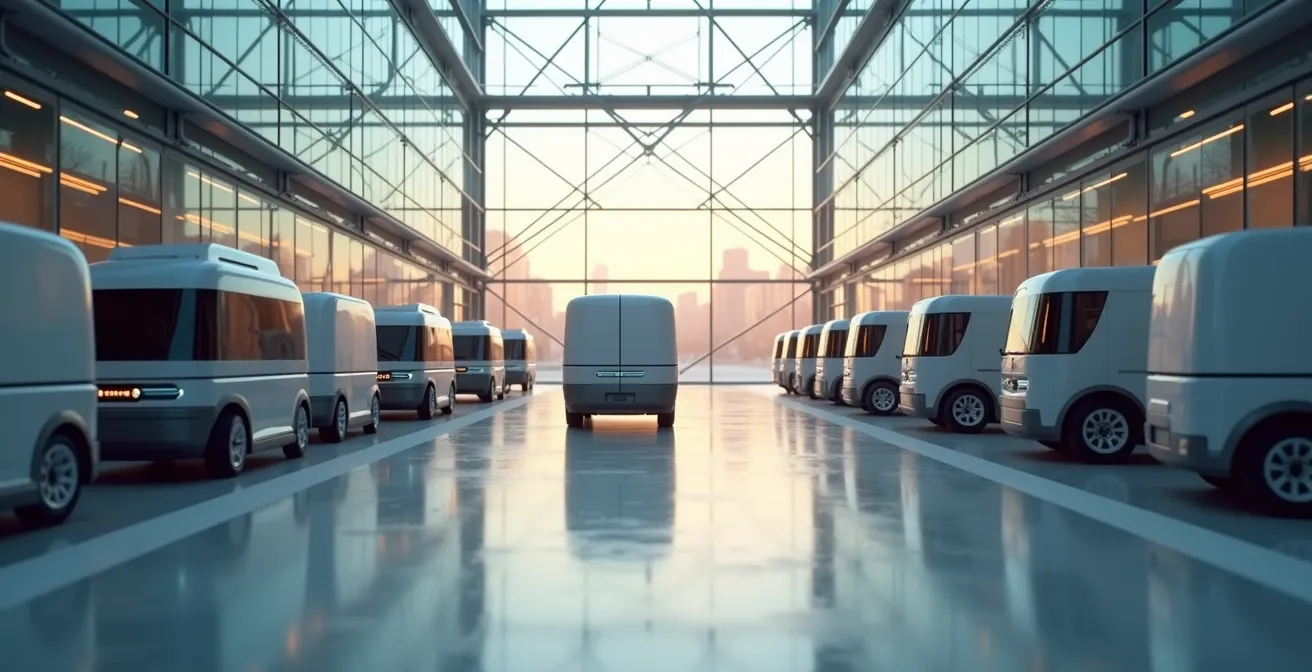
Mastering autonomous last-mile delivery is less about the technology itself and more about making strategic operational trade-offs.
- Maximize ROI by shifting to off-peak charging and rethinking handover security protocols to minimize both energy costs and theft.
- Success depends on systemic integration—blending bots with human drivers, preparing for phased regulatory approvals, and adapting internal logistics.
Recommendation: Focus on building a resilient, data-driven “just-in-case” model rather than trying to perfect an unpredictable “just-in-time” system in urban environments.
For logistics managers, the promise of autonomous electric vehicle (EV) fleets for last-mile delivery is immense: slashed operational costs, enhanced efficiency, and a greener footprint. The conversation often revolves around the futuristic hardware—sleek robots and self-driving vans. However, this focus on technology alone obscures the real challenge. Many early adopters find that simply purchasing autonomous vehicles doesn’t automatically solve the complex, fragmented nature of urban delivery. The true puzzle isn’t acquiring the tech, but integrating it into a chaotic real-world environment.
The standard advice to “optimize routes” and “leverage AI” is a platitude that barely scratches the surface. The path to profitability is littered with critical, and often overlooked, operational decisions. But what if the key to unlocking the full potential of autonomous fleets isn’t in chasing the most advanced sensor suite, but in mastering the new set of logistical trade-offs that this technology creates? This involves a strategic shift from merely managing vehicles to orchestrating a complex system of energy consumption, human-robot interaction, security protocols, and regulatory navigation.
This guide moves beyond the hype to provide a practical framework for logistics innovators. We will dissect the crucial decision points required to build a truly efficient and scalable autonomous delivery network. By focusing on the operational levers you can control—from energy arbitrage to handover methods—we will demonstrate how to transform the last-mile puzzle from an expensive experiment into a competitive advantage.
This article provides a comprehensive look at the strategic decisions you’ll face when implementing an autonomous delivery fleet. The following sections break down each component of the last-mile puzzle, offering data-driven insights and actionable frameworks.
Summary: A Strategic Framework for Autonomous Fleet Management
- Why Charging Your Fleet at 2 AM Saves 30% in Operational Costs?
- How to Train Delivery Bots to Handle Sidewalk Obstacles and Pedestrians?
- Lockers vs Robot Arms: Which Handover Method Reduces Theft Rates?
- The Coordination Challenge: Managing Human Drivers and Bots on the Same Platform
- When will Sidewalk Robots be Legal in Your City?
- When to Move from Closed Loops to Open Traffic: The Safety Milestones?
- AGVs vs Conveyor Belts: Which Material Handling System Offers More Flexibility?
- Why “Just-in-Time” Delivery Fails in Cities with unpredictable Traffic?
Why Charging Your Fleet at 2 AM Saves 30% in Operational Costs?
The transition to an electric autonomous fleet introduces a powerful, often underestimated, lever for cost reduction: energy arbitrage. While the primary benefit of EVs is the elimination of fuel costs, the true financial optimization lies in *when* you charge. Charging a fleet during peak daytime hours can negate a significant portion of savings due to high electricity tariffs. Conversely, shifting the entire charging cycle to off-peak hours, typically between midnight and 6 AM, allows companies to capitalize on significantly lower electricity rates, directly impacting the Total Cost of Ownership (TCO).
This strategy goes beyond simple cost savings. It transforms your depot from a mere parking lot into a dynamic energy asset. An intelligent fleet management platform can automate this process, monitoring energy prices in real-time and initiating charging only when costs are at their lowest. This ensures that every vehicle starts its route with a full battery acquired at the lowest possible price, contributing to a sustainable cost advantage over competitors still reliant on fluctuating diesel prices.
The economic case is further strengthened by reduced maintenance needs. Freed from the complexities of internal combustion engines (ICE), EVs offer significant operational relief. In fact, some fleet operators report maintenance cost savings of 40% or more compared to their diesel counterparts. This reduction stems from fewer moving parts, no oil changes, and less wear on braking systems due to regenerative braking. When combined, strategic off-peak charging and lower maintenance create a powerful one-two punch that can reduce overall operational expenditures by up to 30%, making the initial CAPEX for the fleet a much more digestible investment.
Ultimately, a successful EV fleet isn’t just about owning the vehicles; it’s about mastering their energy lifecycle to create a decisive competitive edge.
How to Train Delivery Bots to Handle Sidewalk Obstacles and Pedestrians?
An autonomous delivery robot’s value is directly tied to its ability to navigate the messy, unpredictable environment of a city sidewalk. Training these bots for real-world complexity requires a sophisticated fusion of hardware and software. The foundation is a rich sensor suite, typically combining LiDAR for precise 3D mapping, cameras for object recognition (like identifying a child versus a fire hydrant), and ultrasonic sensors for close-range obstacle detection. This hardware, however, is only as good as the AI that interprets its data.
This is where sensor fusion and machine learning become critical. Instead of relying on a single data source, the bot’s processor continuously integrates information from all sensors to build a comprehensive, real-time model of its surroundings. Advanced algorithms trained on millions of hours of simulation and real-world data allow the bot to predict pedestrian paths, understand the difference between a stationary lamppost and a moving skateboarder, and make split-second decisions to ensure safety. This continuous learning process, known as federated learning, allows the entire fleet to get smarter with every delivery made by a single unit.

As the image above illustrates, the complexity of the sensor array is paramount for safe operation. Each component plays a role in detecting and classifying objects in the bot’s path. A key operational challenge is managing this decentralized intelligence. A cloud-based fleet management platform provides central oversight, allowing for remote monitoring and intervention if a bot encounters a scenario it cannot resolve, but the goal is to minimize these interventions through robust onboard training.
Action Plan: Key Technologies for Training Delivery Robots
- Implement Machine Learning and AI for real-time decision-making and route optimization to manage uncertain environments.
- Deploy sensor fusion using LiDAR, ultrasonic sensors, IMUs, and GPS for accurate positioning indoors and outdoors.
- Utilize cloud-based fleet management for centralized monitoring and control of multiple robots.
- Enable advanced object recognition and obstacle avoidance algorithms to drastically reduce the chances of collision.
- Apply federated learning where each robot learns locally from its experiences and shares anonymized lessons with the entire fleet.
Ultimately, a well-trained bot is one that becomes an accepted, almost invisible, part of the urban landscape, efficiently completing its tasks without causing disruption or concern.
Lockers vs Robot Arms: Which Handover Method Reduces Theft Rates?
The final moment of delivery—the handover—is the most vulnerable point in the autonomous last-mile chain. Choosing the right handover mechanism is a critical operational trade-off between security, cost, and customer experience. The two dominant approaches, smart lockers integrated into the bot’s chassis and external robotic arms, present distinct risk profiles. A handover security protocol must be a core part of your operational strategy, not an afterthought.
Smart lockers offer the highest level of physical security. The package remains in a sealed, reinforced compartment until the recipient unlocks it via a unique code sent to their smartphone. This method minimizes exposure to opportunistic theft and vandalism. However, it can be slightly less convenient for the customer, who must interact with an interface on the robot. In contrast, a robotic arm offers a more futuristic and direct handover but exposes the item during the transfer, creating a window of vulnerability. Furthermore, the complexity of robotic arms leads to higher maintenance costs and a greater potential for mechanical failure.
To make an informed decision, logistics managers must analyze the specific risks of their operational environment. For high-value goods or deliveries in areas with higher crime rates, the robust security of smart lockers is likely the superior choice. The following table breaks down the key decision-making criteria.
| Feature | Smart Lockers | Robot Arms | Authenticated Direct Handover |
|---|---|---|---|
| Security Level | High – Enclosed compartment | Medium – Exposed during transfer | Very High – Biometric verification |
| Hardware Failure Rate | Low – Simple mechanism | Higher – Complex joints | Medium – Electronic locks |
| Customer Interaction Time | 30-60 seconds | 60-90 seconds | 45-75 seconds |
| Vandalism Resistance | High – Reinforced structure | Low – Exposed components | High – Secure compartment |
| Maintenance Cost | Low | High – Moving parts | Medium |
As this comparative analysis highlights, an emerging third option, authenticated direct handover, combines a secure compartment with biometric or advanced app-based verification, offering a blend of high security and modern user experience. According to Tech Times Research, “Integrated apps provide package tracking, delivery notifications, and contactless unlocking,” which streamlines the process and adds another layer of digital security.
The optimal solution will balance robust security with a frictionless customer interaction, ensuring that the final yard of the delivery journey is as secure and efficient as the miles that preceded it.
The Coordination Challenge: Managing Human Drivers and Bots on the Same Platform
The rollout of an autonomous fleet is rarely a binary switch; it’s a gradual process of systemic integration. For the foreseeable future, logistics operations will be a hybrid environment where human drivers and autonomous bots work side-by-side. The primary challenge is not managing the bots themselves, but orchestrating this mixed workforce through a single, unified platform. A disjointed system where humans and bots operate in separate silos is a recipe for inefficiency, missed handoffs, and operational chaos.
A unified fleet management platform is the nerve center of a successful hybrid operation. It must be capable of dispatching tasks intelligently based on the optimal resource. For example, a long-haul trip from a distribution center to a neighborhood micro-hub might be assigned to a human driver, while the final, dense deliveries within that neighborhood are handled by a fleet of sidewalk bots. The platform needs to provide real-time visibility into the location, status, and capacity of every asset—human or robotic—to make these dynamic assignments.
This integration is already happening at scale. For instance, Serve Robotics, a major player in the space, is rapidly expanding its footprint. The company’s strategy demonstrates the ambition within the sector, as Serve Robotics plans to expand to 2,000 autonomous units across various U.S. cities. This scale necessitates a sophisticated coordination system.
Case Study: Coco’s High-Density Urban Deployment
Coco provides a powerful example of a focused hybrid strategy. By operating over 1,000 autonomous robots in high-density Los Angeles neighborhoods like Santa Monica, the company maximizes the efficiency of its bots for short-range, high-frequency deliveries. Human-operated vehicles are likely used to “feed” these dense operational zones. With over 500,000 deliveries completed, Coco’s model proves that a successful strategy involves defining specific roles for bots within a larger, human-supported logistics network.
Ultimately, the goal is to create a symbiotic relationship where human drivers handle tasks that require their unique problem-solving skills, while bots execute repetitive, short-range deliveries with unparalleled efficiency.
When will Sidewalk Robots be Legal in Your City?
For a logistics manager, the question of legality is not abstract—it’s a critical gating factor for any deployment plan. The regulatory landscape for autonomous sidewalk robots is a complex, evolving patchwork of city ordinances and state laws. There is no single federal mandate, meaning that a robot legal in one city may be prohibited just a few miles away. Therefore, a strategy of risk-adjusted deployment must begin with deep, localized regulatory due diligence.
Progress often comes from pioneering companies working directly with municipalities to conduct pilot programs. These trials serve as crucial proof points, demonstrating the technology’s safety and reliability to regulators and the public. A track record of zero-incident operations is the most powerful argument for broader legal acceptance. Companies that can show thousands of miles driven without a single safety issue are in the strongest position to advocate for favorable regulations.
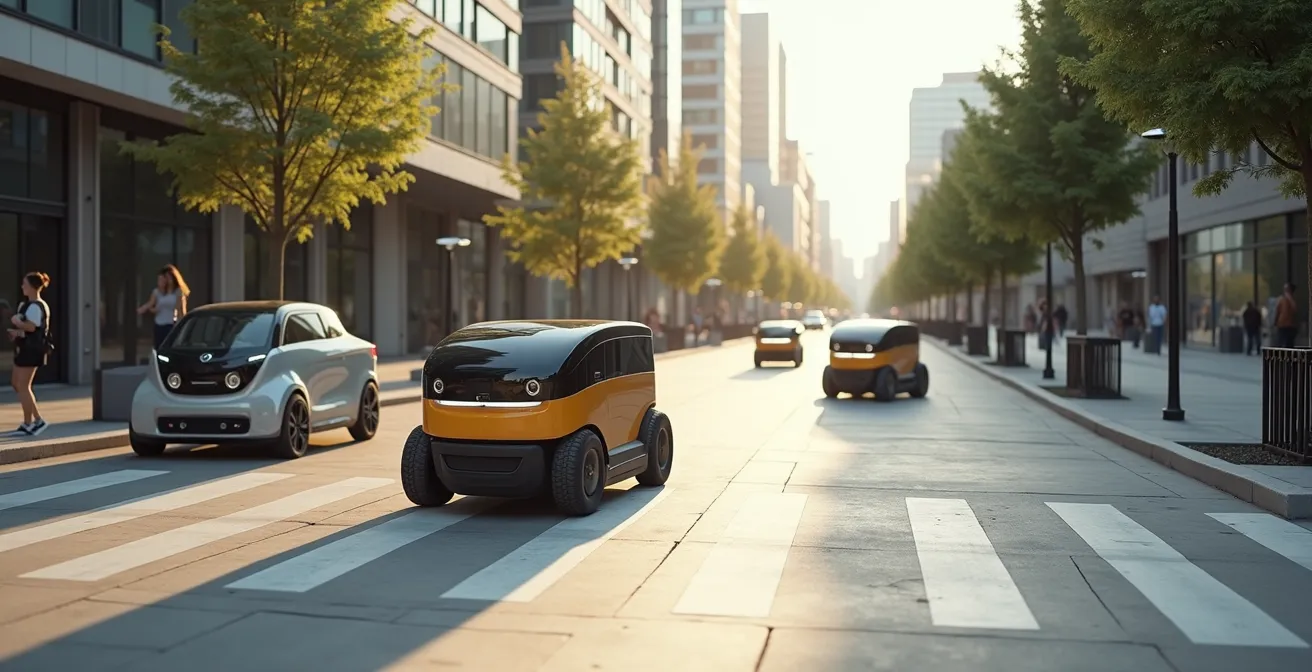
The journey to legalization often involves a phased approach. Regulators may initially grant permits for operation only within specific, low-traffic “Operational Design Domains” (ODDs), such as university campuses or designated commercial districts. As the technology proves itself, these ODDs can be expanded. Global logistics leaders like DHL are at the forefront of these efforts, demonstrating the viability of autonomous systems in real-world public spaces.
DHL carried out a successful trial of AVs in Estonia, with Clevon’s automated robot carriers conducting public road tests, delivering DHL’s internal packages between its three offices in Tallinn. Since then, they have been regularly used in DHL’s fleet for delivery to all customers within the region.
– DHL Logistics, DHL Logistics of Things Report on Autonomous Vehicles
This success is built on a foundation of proven safety. For example, during the Estonian trials, as of September 2023, the robots have driven 5,000+ miles with zero safety incidents, a compelling statistic for any city council. For logistics managers, the takeaway is clear: engage with potential technology partners who have a proven track record of both safety and successful collaboration with regulators.
The question is not just “if” sidewalk robots will be legal, but “how” proactive companies can accelerate that timeline through demonstrable safety and strategic partnerships.
When to Move from Closed Loops to Open Traffic: The Safety Milestones?
The transition from a controlled environment, or “closed loop,” to the chaos of public roads is the single most critical step in deploying an autonomous fleet. This move cannot be a single leap of faith; it must be a carefully managed, milestone-driven process. The core principle is risk-adjusted deployment, where the vehicle’s operational scope is expanded only after its safety and reliability have been rigorously proven in a less complex environment. For logistics managers, approving this transition requires a clear-eyed assessment against a formal safety case.
The journey begins not on the road, but in the virtual world. Extensive simulation, covering billions of virtual miles, is the first milestone. This allows the AI to experience a vast range of scenarios, including rare “edge cases” that would be impractical or dangerous to test in the real world. Only after mastering the virtual environment can physical testing begin, typically within a very limited Operational Design Domain (ODD)—for example, a suburban neighborhood at night with minimal traffic. As the vehicle proves its reliability within that ODD, the domain can be progressively expanded to include more complex scenarios like daytime operation, denser traffic, and adverse weather.
A robust safety framework for this transition includes several non-negotiable elements:
- Teleoperation Command Center: A fully staffed center with trained remote operators must be ready to take instant control of any vehicle at any time.
- Redundancy Validation: All critical systems—perception, braking, steering, and communication—must have proven fail-safes that activate seamlessly in case of a primary system failure.
- Formal Safety Case: Borrowed from the aerospace industry, this methodology requires documented, evidence-based proof that every identifiable risk has been mitigated to an acceptable level.
This methodical approach is crucial for building trust with regulators and the public, paving the way for wider adoption. While delivery bots are leading the charge, the trend toward autonomy is accelerating across the automotive sector. For context, some analysts believe that wider adoption is on the horizon, with McKinsey & Company estimating that 12% of new passenger cars by 2030 will possess sophisticated environmental detection capabilities, a core component of autonomous driving.
Ultimately, a successful open-traffic deployment is the result of a patient, data-driven process that prioritizes safety above all else, ensuring the long-term viability of the technology.
AGVs vs Conveyor Belts: Which Material Handling System Offers More Flexibility?
The efficiency of a last-mile fleet begins long before a robot hits the sidewalk. It starts inside the distribution center or micro-hub, where packages are sorted and loaded. The choice of internal material handling system—traditionally dominated by fixed conveyor belts—is a critical operational trade-off. While conveyors offer high throughput for static, predictable workflows, they are notoriously inflexible. In the dynamic world of e-commerce, this rigidity can become a major bottleneck.
This is where Automated Guided Vehicles (AGVs) offer a paradigm shift. Unlike conveyors, which require a massive upfront CAPEX and a fixed physical footprint, an AGV system is modular and scalable. A company can start with a small number of units and add more as demand grows. Their routes are not physically fixed; they can be reconfigured in software overnight to adapt to new sorting processes, seasonal peaks, or a complete redesign of the warehouse layout. This agility is invaluable for supporting a flexible last-mile operation.
The decision between these systems hinges on the specific needs of the operation. A facility with a highly standardized, unchanging product flow might still benefit from the raw speed of a conveyor. However, for most modern last-mile hubs that deal with a wide variety of package sizes and fluctuating delivery volumes, the flexibility of AGVs provides a decisive long-term advantage. A hybrid approach, using conveyors for a main trunk line and AGVs for sorting and staging, can often provide the best of both worlds.
The following table, adapted for a last-mile fleet support context, illustrates the core trade-offs between these systems.
| Criteria | AGVs | Conveyor Belts | Hybrid System |
|---|---|---|---|
| Initial Investment | Scalable – Start small | High CAPEX upfront | Moderate – Phased approach |
| Layout Flexibility | Excellent – Reconfigurable | Poor – Fixed installation | Good – Strategic placement |
| Throughput | Variable | High for static flows | Optimized for both |
| Maintenance | Per unit basis | System-wide impact | Distributed risk |
| Scalability | Add units as needed | Major modifications required | Best of both approaches |
| Process Adaptation | Real-time optimization | Static workflow | Dynamic + Reliable base flow |
By opting for a more flexible internal system like AGVs, logistics managers can create a foundation that supports, rather than constrains, a dynamic and scalable autonomous last-mile fleet.
Key Takeaways
- True cost savings from EV fleets come from strategic off-peak charging (energy arbitrage) and reduced maintenance, not just fuel elimination.
- The security of the final handover is a critical trade-off; smart lockers offer superior security, while robotic arms present higher risks and maintenance costs.
- Successful autonomous deployment is a phased, milestone-driven process, moving from simulation to closed loops and finally to limited open traffic based on a formal safety case.
Why “Just-in-Time” Delivery Fails in Cities with unpredictable Traffic?
For decades, “Just-in-Time” (JIT) has been the holy grail of supply chain management, aiming to minimize inventory by having goods arrive exactly when needed. However, this model is fundamentally brittle and ill-suited for the chaotic reality of urban last-mile delivery. Unpredictable traffic, road closures, and a high density of delivery points make precise arrival times nearly impossible to guarantee. Attempting to force a JIT model onto this environment leads to failed deliveries, frustrated customers, and spiraling operational costs.
Autonomous delivery technology, paradoxically, offers the solution by enabling a shift away from JIT towards a more resilient “Just-in-Case” (JIC) or buffered model. Instead of promising a precise delivery window, a fleet of autonomous bots can create a continuous, flowing pipeline of goods into a neighborhood. Bots can be pre-loaded and dispatched from a micro-hub based on aggregate demand, not a specific timed order. This creates a local “buffer” of products on the move, allowing for near-instantaneous fulfillment once a customer places an order, without being hostage to real-time traffic from a distant warehouse.
This strategic shift is already being validated in the market. The ultimate goal is to build a logistics network that is resilient to the inherent unpredictability of city life. The growing market size reflects this vast opportunity; by one estimate, the autonomous last-mile delivery market will grow to $91.5 billion by 2030. Capturing a share of this market requires a fundamental rethinking of delivery strategy.
Case Study: Waymo and Uber Eats in Phoenix
The partnership between Waymo and Uber Eats to deliver food in several Phoenix-area cities is a prime example of this emerging model. By deploying a fleet of autonomous Jaguar I-PACE EVs, they can service select merchants and fulfill orders without being tied to a specific human driver’s availability. As the service area grows and more restaurants are added, Waymo is building a network that can absorb demand dynamically, showcasing a more robust approach than traditional, driver-dependent JIT food delivery.
To truly solve the last-mile puzzle, logistics managers must move beyond the fragile promises of “Just-in-Time” and leverage autonomous technology to build the robust, responsive, and ultimately more profitable supply chain of the future. Evaluate your current strategy today to see how a buffered, autonomous model can create a more resilient and cost-effective operation.