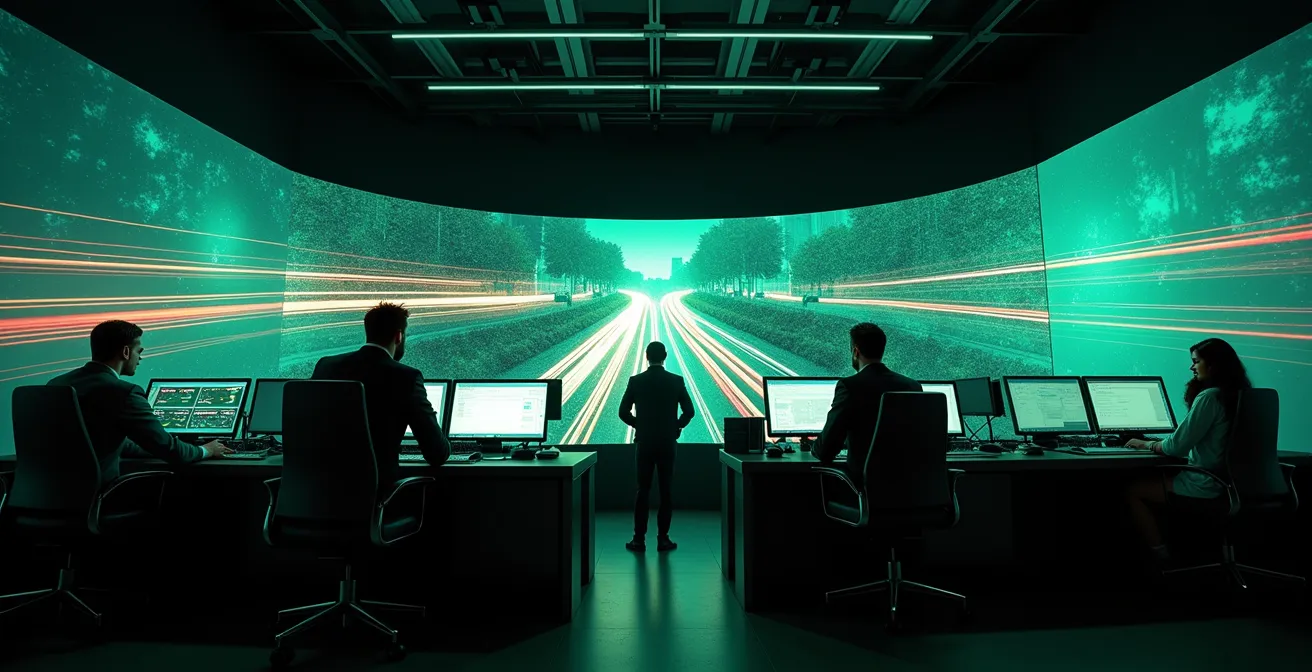
AI traffic management consistently outperforms physical infrastructure expansion by optimizing existing networks, directly reducing commute times, operational costs, and emissions.
- Success hinges on moving from fixed-time signals to adaptive systems that react to real-time, network-level demand.
- Quantifying the cost of congestion in lost productivity and fuel is the first step toward justifying investment in AI-driven solutions.
Recommendation: Focus on implementing data standardization (like GTFS and C-V2X) and probabilistic planning models to achieve predictable, efficient urban mobility.
For decades, the default solution to urban gridlock has been building more roads. Yet, traffic engineers know this often leads to induced demand, filling the new capacity almost as quickly as it’s built. The focus is shifting from costly construction to intelligent optimization. While the concept of “smart traffic lights” is often discussed, it’s a simplification that misses the fundamental change in operational philosophy. The true revolution lies not in isolated smart signals, but in viewing the entire city’s road network as a single, dynamic system governed by the physics of traffic flow.
The traditional approach of using fixed-time signal plans based on historical averages is fundamentally broken in an era of unpredictable events, ride-sharing surges, and just-in-time logistics. This approach is reactive and inefficient. The paradigm shift enabled by AI is moving from managing intersections to orchestrating traffic flow at a network level. It’s about making predictive, system-wide trade-offs in real time. But if the core of this transition isn’t just about “smarter” signals, what is it? It’s about understanding the algorithmic levers that allow an engineer to become a system architect, manipulating flow, priority, and capacity based on live data, not historical guesses.
This article will deconstruct the core mechanisms of AI traffic platforms. We will analyze how adaptive signal control works in practice, explore its configuration for complex scenarios like stadium egress, and examine its life-saving application for emergency services. We will also dissect common system failures, like phantom jams, and delve into the data standards required for true city-wide integration. Finally, we will provide a framework for quantifying the financial impact of traffic, making the case for technology over tarmac.
This guide provides a comprehensive overview of the principles and applications of AI in traffic management. The following sections break down key concepts, from foundational technologies to advanced financial calculations, to equip you with a full understanding of the subject.
Summary: AI Traffic Platforms vs. New Roads: Clearing Urban Gridlock Faster?
- Why Adaptive Signal Control Reduces Commute Time by 20%?
- How to configure Algorithms to Handle Stadium Exits After a Match?
- Green Wave for Ambulances: How to Automate Priority Lanes via GPS?
- The Algorithm Mistake That Creates Phantom Traffic Jams on Highways
- How to Feed City Data to Google Maps to Reroute Cars in Real-Time?
- Why Increasing Speed at Station A Causes a Jam at Station B?
- Why “Just-in-Time” Delivery Fails in Cities with unpredictable Traffic?
- How to Calculate the Hourly Cost of Your Sales Team Sitting in Traffic?
Why Adaptive Signal Control Reduces Commute Time by 20%?
Adaptive Traffic Signal Control (ATSC) represents a fundamental departure from traditional pre-timed signals. Instead of relying on fixed cycles based on historical averages, ATSC systems use real-time data from sensors—such as induction loops, radar, and video cameras—to adjust signal timings dynamically. This allows the system to respond to actual traffic demand as it happens, rather than what was predicted. The core principle is to treat intersections not as isolated points, but as nodes in a connected network. The algorithm’s goal is to optimize the flow across this entire network, minimizing stops and delays for the greatest number of vehicles.
This network-level optimization is what yields significant improvements in traffic flow. By analyzing data from multiple intersections simultaneously, the system can create “green waves” that move platoons of vehicles through a corridor without stopping. This is a level of coordination impossible with isolated, pre-timed signals. The results are quantifiable and substantial. For example, the SURTRAC system implemented in Pittsburgh demonstrated a 25% reduction in travel times and a 40% decrease in wait times. Similarly, the Los Angeles Department of Transportation (LADOT) saw its AI-powered system reduce traffic congestion by up to 16% in certain areas by using predictive analytics to anticipate traffic patterns.

As seen in the visualization of an optimized network, the system doesn’t just manage one intersection; it orchestrates the flow across many. It makes constant, small adjustments to signal phasing and cycle lengths to prevent queues from forming and to clear existing congestion efficiently. This transition from static management to a dynamic, responsive system is the primary driver behind the significant reductions in commute times and vehicle emissions, offering a high-return investment compared to the cost of new infrastructure.
How to configure Algorithms to Handle Stadium Exits After a Match?
Large-scale events, such as concerts or sports matches, present a unique and predictable challenge: a massive, concentrated surge of traffic in a short period. A standard adaptive traffic plan is insufficient for this scenario; it requires a specific “event mode” configuration that prioritizes egress from a defined zone. The algorithm must be temporarily re-weighted to prioritize clearing vehicles and pedestrians from around the venue, even at the expense of temporarily increased delays on non-critical adjacent corridors. This is a classic example of a required algorithmic trade-off.
The process involves pre-planning and real-time execution. Engineers define specific egress corridors and assign them the highest priority. The AI system can then run predictive simulations based on ticket sales and historical data to anticipate the volume and direction of traffic flow. When the event ends, the system automatically activates the event plan, creating a continuous green wave along the main exit routes. A trial by Kirklees Council in the UK demonstrated this effectively, showing its AI-managed corridors handled 10,000 extra journeys with free-flowing traffic after a 33,000-fan event. This level of management is impossible with static signal plans.
For traffic engineers, configuring the system for these events involves a clear, step-by-step process to balance multiple competing objectives and ensure a smooth, safe dispersal of large crowds. The key is to define priorities and let the system execute the complex signal coordination required.
Action Plan: Configuring AI for Large Event Egress
- Run predictive egress simulations 30 minutes before event ends using historical attendance data.
- Define temporary high-priority ‘event zones’ with dynamic weight assignments for exit routes.
- Integrate real-time ride-sharing app data (Uber/Lyft) to anticipate surge demand patterns.
- Create designated pick-up zones with synchronized traffic signals for for-hire vehicles.
- Balance competing objectives: stadium egress speed, critical arterial flow, public transit priority, and emergency access.
Green Wave for Ambulances: How to Automate Priority Lanes via GPS?
In emergency response, every second counts. Emergency Vehicle Preemption (EVP) is a critical application of AI traffic management that provides a clear, automated path for first responders. The system uses GPS transmitters on emergency vehicles (ambulances, fire trucks) to communicate their real-time location and intended route directly to the central traffic management platform. This is a form of Vehicle-to-Infrastructure (V2I) communication. As the vehicle approaches an intersection, the system automatically turns the traffic signal green in its direction of travel while turning all conflicting signals red.
This creates a “green wave” that allows the emergency vehicle to pass through a series of intersections without ever slowing down or navigating through congested traffic. The impact on response times is dramatic. According to a joint US Department of Transportation and Federal Highway Administration safety report, EVP systems can lead to a 50% reduction in emergency response times. This technology not only saves lives by getting responders to the scene faster but also significantly improves safety by reducing the risk of collisions at intersections when an emergency vehicle would otherwise have to run a red light.

The technology is continuously evolving with the advent of V2X (Vehicle-to-Everything) communication. As noted by one industry expert, this technology is already being deployed in real-world scenarios. As Focal Point Positioning highlights in their analysis on V2X technology:
In 2024, the first European deployment of V2X alerting in firefighting took place in the UK, with Avon Fire & Rescue Service using HAAS Alert’s digital alerting system
– Focal Point Positioning, V2X for Safety: Vehicle-to-Everything Technology for Emergency Vehicle Management
This automated priority system is one of the most compelling arguments for AI-driven traffic platforms, demonstrating a clear, life-saving return on investment that goes far beyond simple convenience.
The Algorithm Mistake That Creates Phantom Traffic Jams on Highways
A “phantom traffic jam” is a frustratingly common phenomenon where traffic on a highway slows to a crawl for no apparent reason, such as an accident or lane closure. From a traffic physics perspective, this is a shockwave effect. It’s typically initiated by a single driver braking unnecessarily hard, causing the driver behind to brake even harder, and so on. This creates a wave of deceleration that travels backward through the traffic flow, long after the initial cause has disappeared. Traditional traffic management is helpless against this, as it’s a driver behavior problem.
However, AI-driven systems utilizing Vehicle-to-Vehicle (V2V) and Vehicle-to-Infrastructure (V2I) communication can mitigate and even prevent these shockwaves. The algorithmic mistake in older systems is treating each vehicle as an independent agent. A modern algorithm treats the platoon of vehicles as a collective. When a system detects a slowdown ahead (e.g., from a connected car’s braking data or roadside sensors), it can send a “queue warning” to all vehicles approaching the area. This allows drivers to decelerate smoothly and gradually over a longer distance, absorbing the speed differential without hard braking.
Case Study: Indiana DOT’s Work Zone Queue Warning
A pilot study by the Indiana Department of Transportation provides a powerful demonstration of this principle. By deploying trucks with queue warning systems ahead of interstate work zones, they were able to alert motorists to slowed or stopped traffic ahead. The result, documented in a V2X deployment study, was an 80 percent reduction in hard braking events. This directly breaks the chain reaction that creates phantom jams, proving that proactive information dissemination is a highly effective countermeasure.
By preventing the sharp, sudden speed changes that trigger shockwaves, the algorithm maintains a smoother, more consistent flow of traffic. This not only reduces travel time and driver frustration but also has significant secondary benefits, such as improved fuel efficiency and lower emissions, by eliminating unnecessary acceleration and deceleration cycles.
How to Feed City Data to Google Maps to Reroute Cars in Real-Time?
For a city’s traffic management system to influence platforms like Google Maps or Waze, it must speak their language. This “language” consists of standardized data formats that allow for the seamless exchange of real-time information about road conditions, closures, public transit schedules, and incidents. Without this data sharing, the city’s AI platform and consumer navigation apps operate in separate silos, leading to suboptimal routing for drivers and an incomplete picture for traffic engineers. The key to integration is adopting and publishing data through universally recognized specifications.
The most crucial part of this process is for a municipal transportation agency to act as a reliable publisher of high-quality, real-time data. This involves not only sharing information about planned events like roadwork or parades but also streaming dynamic data from the AI traffic system itself, such as real-time congestion levels or signal phasing. This is being implemented at scale, as seen with NoTraffic’s system being approved for statewide use in Florida, enabling traffic authorities to manage and prioritize flow across all transportation modes and share that data. This creates a powerful feedback loop: the city provides accurate ground-truth data, and navigation apps use it to route drivers more efficiently, which in turn helps balance the load on the city’s network.
The following table, based on information from a US Government Accountability Office report, outlines the key data standards that facilitate this vital communication between public and private transportation entities.
| Standard Format | Purpose | Data Type | Key Users |
|---|---|---|---|
| GTFS (General Transit Feed Specification) | Transit data sharing | Schedule, routes, stops | Google Maps, Transit apps |
| DSRC (5.9 GHz) | V2I communication | Real-time vehicle data | Traffic management centers |
| C-V2X (Cellular) | Connected vehicle data | Location, speed, incidents | Navigation platforms |
By adopting these standards, a city moves from being a passive observer of traffic to an active participant in the digital navigation ecosystem, using its own data as a powerful tool to manage and influence traffic flow in real-time.
Why Increasing Speed at Station A Causes a Jam at Station B?
A common but counter-intuitive error in traffic management is local optimization—the practice of improving flow at one specific point without considering its downstream effects. This is the “Station A / Station B” problem. Imagine a highway where an on-ramp (Station A) is widened or its traffic light is optimized to allow more cars to enter the highway faster. This locally seems like an improvement. However, if the highway itself, a few miles downstream (Station B), is already at or near its maximum capacity, this surge of new vehicles from Station A will overload it, causing a bottleneck and creating a jam that is far worse than the original on-ramp delay.
This illustrates a core principle of network-level physics: a traffic network’s total throughput is limited by its most constrained point. Increasing flow into a bottleneck does not improve the system; it breaks it. AI-driven traffic management platforms are designed to avoid this fallacy by maintaining a holistic, network-wide view. Instead of just measuring the queue at Station A, the algorithm analyzes the capacity and current volume at Station B. It will then dynamically “meter” the flow from Station A, releasing vehicles at a rate that the downstream network can absorb without collapsing. This is the principle behind ramp metering systems on highways.

This system-wide approach, often using techniques like reinforcement learning, consistently outperforms local optimization. Studies on real-world signal optimization have shown that such holistic systems achieve significant improvements in overall network performance. By understanding that the entire road network functions like a system of interconnected pipes and funnels, engineers can use AI to balance flow across the entire system, rather than inadvertently causing jams by fixing a problem in isolation. This is what systems like the one in Phoenix, which reduced vehicle delay by 40%, excel at—coordinating the entire network, not just individual lights.
Why “Just-in-Time” Delivery Fails in Cities with unpredictable Traffic?
The “Just-in-Time” (JIT) manufacturing and logistics model is built on a foundation of predictability. It assumes that components and goods will arrive at a factory or warehouse at the precise moment they are needed, minimizing storage costs and maximizing efficiency. This works well when transportation legs are predictable, such as with long-haul freight on dedicated routes. However, this model often breaks down in the final-mile delivery stage within a dense urban environment because city traffic is inherently unpredictable.
Urban traffic variance is caused by a host of factors: minor accidents, special events, weather, ride-sharing surges, and even the simple randomness of human behavior. A deterministic plan that assumes a delivery will take 25 minutes can be completely derailed by a 15-minute delay, causing a cascade of disruptions in a tightly scheduled supply chain. This forces logistics companies to build in large, inefficient “buffer times” to their schedules, which negates the entire purpose of JIT. The core failure is applying a deterministic model to a probabilistic system.
AI-powered platforms offer a solution by embracing this uncertainty. Instead of relying on fixed travel times, they use probabilistic planning models. These systems provide a range of likely travel times (e.g., “18-32 minutes with 90% confidence”) based on real-time sensor data and historical analysis. This allows logistics operators to make smarter, data-driven decisions. The key AI-powered strategies to overcome urban JIT failure include:
- Implementing probabilistic planning models instead of deterministic fixed travel times.
- Utilizing AI to quantify traffic variance in real-time through sensor fusion.
- Deploying dynamic slotting systems with flexible delivery windows (e.g., 9:50-10:15 AM).
- Analyzing historical traffic data to identify chronically unreliable corridors.
- Automatically rerouting supply chains away from recurring congestion zones.
By quantifying unpredictability, AI systems transform it from an unknown risk into a managed variable, making urban logistics more resilient and efficient.
Key Takeaways
- Network-level optimization is superior: Improving a single intersection can worsen overall system flow if it creates a downstream bottleneck.
- AI transforms engineers into system architects: The goal shifts from managing signals to orchestrating traffic flow using data-driven, algorithmic trade-offs.
- Quantifiable ROI is the foundation: Calculating the financial cost of congestion in lost productivity, fuel, and opportunity cost is essential for justifying technology investments.
How to Calculate the Hourly Cost of Your Sales Team Sitting in Traffic?
For any organization with a mobile workforce, such as a field sales team or service technicians, traffic congestion is not just an inconvenience—it’s a direct and substantial operating cost. Time spent in gridlock is time not spent with clients, completing jobs, or generating revenue. Quantifying this cost is the first and most critical step for a traffic engineer or city planner to build a business case for investing in AI-driven traffic management solutions. The impact is enormous; for instance, Los Angeles’s AI-synchronized signal system is estimated to save drivers 9.5 million hours annually.
To calculate this cost at an organizational level, a “fully-loaded” hourly rate must be established for each employee. This figure goes beyond simple salary; it includes benefits, payroll taxes, vehicle costs, insurance, and other overhead. Once this rate is known, it can be multiplied by the number of hours lost to traffic delays, which can be tracked via vehicle telematics or GPS data from CRM check-ins. However, the calculation doesn’t stop there. The opportunity cost—the value of the meetings or service calls that were missed or delayed—often far exceeds the direct labor cost.
The following framework, derived from public works analyses, breaks down the key components needed to perform a comprehensive cost calculation. This data-driven approach transforms the abstract problem of “traffic” into a concrete financial metric that justifies investment in optimization technologies.
| Cost Component | Calculation Method | Data Source | Impact Factor |
|---|---|---|---|
| Lost Hours | Vehicle telematics / CRM check-ins | GPS tracking systems | Direct productivity loss |
| Fully-Loaded Hourly Rate | Salary + benefits + taxes + vehicle costs | HR records | Total employment cost |
| Opportunity Cost | Avg revenue per meeting × missed meetings | Sales CRM data | Revenue impact |
| Schedule Padding Cost | Extra buffer time × number of meetings | Calendar analysis | Hidden productivity drain |
| Turnover Cost | Replacement cost due to traffic frustration | Exit interviews | Long-term HR impact |
By systematically applying this framework, organizations and municipalities can move beyond anecdotal complaints and build a powerful, data-backed argument for adopting AI traffic solutions that demonstrably boost productivity and reduce operational waste.