
Viewing smart city technology as a recurring expense is a fiscal error; the key to sustainable ROI is treating it as a depreciable municipal asset with a fully budgeted 20-year lifecycle.
- Initial savings from projects like LED lighting are misleading without accounting for long-term maintenance, data management, and eventual replacement.
- Procurement choices that prioritize open standards and modularity over proprietary systems directly reduce future financial liabilities and prevent digital decay.
Recommendation: Shift from project-based ROI calculations to a comprehensive Total Cost of Ownership (TCO) model that includes planned capital expenditures for technology refresh cycles.
For municipal finance officers and city planners, the pressure to deliver “smart” and “green” urban solutions is immense. The market is flooded with technologies promising immediate cost savings and a reduced carbon footprint. We are often presented with compelling figures on energy reduction from smart lighting or efficiency gains from route optimization. These short-term returns are attractive and often serve as the primary justification for significant capital outlay. However, this focus on immediate payback obscures a much larger, more critical financial reality.
The conventional approach treats technology as a simple purchase, a one-time expense that yields a benefit. This is a profound miscalculation. The true challenge—and the key to unlocking sustainable, long-term ROI—is to stop thinking about technology and start thinking about infrastructure. Smart city systems are not gadgets; they are the digital equivalent of our roads, water pipes, and electrical grids. They require ongoing maintenance, face inevitable obsolescence, and carry hidden liabilities related to data, security, and e-waste.
This article reframes the conversation. Instead of asking “How quickly does it pay for itself?”, we will ask, “What is the total cost of owning and operating this asset over a 20-year fiscal horizon?” The real measure of success is not the initial savings, but the creation of a fiscally resilient system where technology’s entire lifecycle is budgeted for from day one. It’s a shift from tactical procurement to strategic asset management. By adopting this fiscal discipline, we can ensure that our investments in green tech build lasting value rather than becoming a future financial burden.
This guide provides a fiscal advisor’s perspective on structuring these investments. We will explore tangible project ROIs, the hidden costs of procurement, and the frameworks needed to budget for the full lifecycle of your city’s digital infrastructure.
Summary: A Fiscal Framework for Smart City ROI
- Why Smart Street Lighting Cuts Municipal Energy Bills by 40%?
- How to Use IoT Bins to Optimize Garbage Truck Routes?
- Top-Down vs Bottom-Up: Which Smart City Model Do Citizens Actually Trust?
- The “Green” Trap: Buying Tech That Looks Sustainable But Increases E-Waste
- How to Budget for the Upkeep of Smart Infrastructure over 20 Years?
- Why Disruptive Tech Is Essential for Reducing Urban Carbon Footprints?
- When to Replace Sensors: Defining End-of-Life Metrics for City Tech?
- Maintaining IoT Infrastructure: How to Prevent Digital Decay in Smart Cities?
Why Smart Street Lighting Cuts Municipal Energy Bills by 40%?
Smart street lighting is often the gateway project for municipal smart city initiatives, and for good reason: the return on investment is direct, measurable, and substantial. While the title suggests a 40% reduction, the potential is often even greater. According to the Clean Energy Ministerial, municipalities can achieve up to 50% energy savings by upgrading to connected LED systems. This moves lighting from a fixed operational cost to a dynamically managed asset.
The primary saving comes from two sources: the inherent efficiency of LED technology over traditional sodium-vapor lamps and the “smart” control layer. This layer allows for dynamic dimming based on real-time conditions, such as late-night hours with low traffic or even ambient moonlight. Furthermore, integrated sensors provide real-time data on lamp performance, enabling a shift from costly, reactive group maintenance to a predictive, single-point repair model. Instead of replacing entire blocks of lights on a fixed schedule, crews are dispatched only when a specific unit reports a fault.

However, the most significant long-term value lies in viewing the streetlight pole as a platform. These powered, connected, and strategically located assets can host additional sensors for air quality monitoring, traffic counting, public Wi-Fi, and even 5G small cells. This transforms a simple cost-saving project into a revenue-generating or value-adding infrastructure backbone, fundamentally altering its ROI calculation from a simple payback period to a long-term asset value proposition.
How to Use IoT Bins to Optimize Garbage Truck Routes?
Waste management represents a significant operational expenditure for any municipality, dominated by fuel, vehicle maintenance, and labor costs. The traditional model of fixed-route, fixed-schedule collection is inherently inefficient, leading to trucks servicing empty bins while others overflow. IoT-enabled waste bins disrupt this model by introducing data-driven logistics, directly impacting the bottom line.
The mechanism is straightforward: each bin is equipped with an ultrasonic sensor that monitors its fill level in real-time. This data is transmitted to a central platform, which then generates dynamic collection routes. Trucks are dispatched only to bins that are at or near capacity, eliminating wasted trips. The impact on operational expenditure (OpEx) is immediate and threefold: a dramatic reduction in fuel consumption, decreased wear and tear on collection vehicles, and optimized allocation of labor hours.
While specific ROI varies, the efficiency gains are undeniable. The system’s intelligence compounds over time. By integrating historical fill-level data with AI, municipalities can develop predictive waste generation models. This allows for proactive fleet management based on seasonality, local events, or neighborhood-specific patterns. For example, sanitation departments can anticipate surges in waste near stadiums on game days or in parks during summer holidays, allocating resources precisely where and when they are needed.
From a fiscal perspective, this technology transforms a static, high-cost service into a dynamic, responsive, and cost-optimized operation. The initial capital expenditure (CapEx) for sensors and software is offset by sustained, year-over-year reductions in operational costs, presenting a clear and defensible investment case for budget approval.
Top-Down vs Bottom-Up: Which Smart City Model Do Citizens Actually Trust?
A smart city project’s financial success is not solely dependent on the technology’s efficiency; it is heavily influenced by public adoption and trust. A lack of citizen buy-in can lead to underutilization, vandalism, and ultimately, project failure, turning a promising investment into a sunk cost. The strategic choice between a top-down and a bottom-up implementation model is therefore a critical variable in the ROI equation.
The top-down model, driven by a central authority, promises efficiency and rapid deployment but often fails to address genuine community needs. It risks being perceived as intrusive surveillance, particularly when personal data is involved. The bottom-up model, while involving higher initial consultation costs and slower deployment, builds projects around citizen-identified problems, fostering a sense of ownership and increasing adoption rates. This community ownership translates directly into lower maintenance costs and greater long-term value.
Cautionary Tale: The Failure of Top-Down Ambition
The risk of ignoring the citizen perspective is not theoretical. High-profile, top-down projects have demonstrated the financial peril of this approach. For instance, the Sidewalk Labs’ Quayside project in Toronto and its spin-off company Replica’s work in Oregon were both met with significant public backlash over data privacy and a lack of community engagement. As a result, these ambitious, tech-first initiatives were ultimately scrapped, representing millions in wasted planning and development costs.
The following table outlines the fiscal trade-offs between these two approaches. From a long-term financial advisor’s perspective, the higher initial investment in community engagement under a bottom-up model is a form of risk mitigation that yields superior, more durable returns.
| Aspect | Top-Down Model | Bottom-Up Model |
|---|---|---|
| Initial Costs | Lower consultation costs | Higher initial consultation costs |
| Adoption Rates | Variable, often lower | Higher due to citizen buy-in |
| Maintenance Costs | Higher vandalism/damage rates | Lower due to community ownership |
| Data Sharing | Resistance to sharing personal data | Increased willingness to share |
| Long-term ROI | Risk of project failure | Superior long-term returns |
The “Green” Trap: Buying Tech That Looks Sustainable But Increases E-Waste
In the rush to adopt green technology, municipalities can fall into a significant fiscal trap: investing in systems that appear sustainable upfront but create long-term liabilities through e-waste and vendor lock-in. A solution that requires the complete replacement of hardware every few years due to proprietary software or non-modular design is not sustainable—it’s a recurring expense disguised as a capital investment. This is a critical area where procurement policy directly impacts long-term ROI.
The core of the problem lies in proprietary ecosystems. When a city commits to a single vendor’s closed system, it becomes dependent on that vendor for all future upgrades, repairs, and software updates. This lack of interoperability creates a significant financial risk. As ESI ThoughtLab notes in its “Building a Hyperconnected City” study, this is a form of technical debt.
Every proprietary choice or interoperability shortcut is a ‘debt’ that will eventually have to be ‘repaid’ with high interest.
– ESI ThoughtLab, Building a Hyperconnected City Study
To avoid this trap, procurement must shift its focus from initial purchase price to total lifecycle cost and asset longevity. A procurement strategy grounded in circular economy principles prioritizes modularity, open standards, and vendor commitment to end-of-life management. This approach treats technology as a durable asset, not a disposable good, safeguarding the city’s investment and minimizing future unfunded liabilities.
Action Plan: Circular Economy Procurement Scorecard
- Modularity Assessment: Score vendors on the availability of replaceable parts versus the need for entire unit replacement. Demand modular designs for critical components.
- Material Sourcing Audit: Evaluate and give preference to vendors who utilize a high percentage of recycled materials in the manufacturing of their hardware.
- End-of-Life Program Verification: Assess the vendor’s commitment and track record with end-of-life take-back or recycling programs. Is this a contractual obligation or a marketing promise?
- Open Standards Compliance Check: Verify compatibility with established open standards (e.g., MQTT, LoRaWAN) to prevent vendor lock-in and ensure future interoperability.
- Software Upgradeability Guarantee: Scrutinize the vendor’s policy on software and firmware updates. Ensure a long-term support guarantee to prevent premature hardware obsolescence forced by software incompatibility.
How to Budget for the Upkeep of Smart Infrastructure over 20 Years?
The true test of a smart city’s financial strategy is not the success of its initial projects, but its ability to sustain them over decades. A sensor network or data platform without a long-term maintenance and replacement budget is not an asset; it is a future crisis. The scale of this challenge is immense; to modernize infrastructure, it’s estimated that US municipal governments will invest roughly $41 trillion over 20 years. A portion of this will be smart tech that requires a new kind of fiscal planning.
Effective long-term budgeting requires a fundamental shift in mindset: treating digital infrastructure with the same rigor as physical infrastructure. This means establishing a Total Cost of Ownership (TCO) model that extends far beyond the initial purchase. The budget must include line items for:
- Preventative Maintenance: Regular software patches, security audits, and physical sensor cleaning/calibration.
- Data Management & Storage: The recurring, and often escalating, costs of cloud or on-premise data infrastructure.
- Connectivity Costs: Cellular, fiber, or LPWAN network subscription fees.
- Digital Depreciation & Replacement Fund: Systematically setting aside capital to fund the planned obsolescence and replacement of hardware at the end of its 5, 10, or 15-year lifecycle.
When managed with this discipline, the returns can be transformative, creating new revenue streams and efficiencies that fund the system’s own upkeep.
Success Story: Barcelona’s Sustainable ROI Model
The city of Barcelona provides a powerful example of this long-term approach. Through intelligent infrastructure, the city is not only saving €42.5 million (U.S. $48 million) on water annually but is also generating an additional €36.5 million ($40 million) in parking revenue each year. This combination of cost savings and new revenue generation creates a sustainable financial loop. Furthermore, these smart city investments have helped create approximately 47,000 new jobs, adding significant economic value that compounds the direct financial ROI.
Why Disruptive Tech Is Essential for Reducing Urban Carbon Footprints?
While fiscal responsibility is paramount, the driving mandate for many smart city investments is environmental. Cities are at the forefront of the climate challenge; a report from the Climate Investment Funds highlights that cities consume more than 75% of the world’s energy and are responsible for a similar share of global CO2 emissions. Incremental improvements are no longer sufficient; disruptive technologies are essential to achieve meaningful carbon reductions at an urban scale.
Disruptive green tech creates efficiencies that are impossible with traditional systems. It’s the difference between asking citizens to use less water (incremental) and deploying a sensor network that detects and locates leaks in the municipal water main in real-time (disruptive). It’s the difference between promoting carpooling (incremental) and implementing an intelligent traffic management system that adjusts signal timing based on live flow, reducing idling and congestion across the entire grid (disruptive).
These technologies allow cities to move from managing consumption at the endpoint to optimizing the entire system. The McKinsey Global Institute validates this potential, estimating that smart city implementations can directly reduce greenhouse gas emissions by 10-15%. This is achieved through more efficient energy grids, optimized building energy use, reduced traffic congestion, and streamlined city services like waste management. For a finance officer, this environmental return is also a financial one, mitigating climate-related risks and often unlocking access to green bonds and federal sustainability grants.
When to Replace Sensors: Defining End-of-Life Metrics for City Tech?
A critical component of long-term budgeting for smart infrastructure is knowing when to replace it. Unlike a bridge, which has a predictable physical lifespan, a sensor’s “end-of-life” is a more complex variable. Simply waiting for it to fail is a reactive and costly strategy. A proactive approach requires defining clear, performance-based metrics for replacement, ensuring that the city’s capital is deployed efficiently.
While most smart city projects see initial returns within 3-5 years, the useful life of the hardware can be much longer if managed correctly. The decision to replace a sensor or an entire network should be data-driven, not calendar-driven. Key metrics for defining end-of-life include:
- Data Drift: The gradual deviation of a sensor’s readings from established accuracy benchmarks over time. When drift exceeds a predefined tolerance and cannot be corrected by recalibration, the sensor is fiscally obsolete.
- Precision Decay: A noticeable loss in the sensor’s measurement granularity. An air quality sensor that can no longer distinguish between 10 and 15 parts per million has reached the end of its useful life for that application.
- Comparative Obsolescence: The point at which the capabilities (and cost) of a new generation of sensors offer a compelling ROI for replacement, even if the existing hardware is still functional.
- Security Vulnerability: When a device’s hardware can no longer support critical security patches, it becomes a liability and must be decommissioned.
By establishing a framework that monitors these metrics, you can create a predictive replacement schedule. This allows for the creation of a dedicated capital replacement fund, turning unpredictable failures into a planned, budgeted expenditure and ensuring the continuous integrity of the city’s data infrastructure.
Key Takeaways
- Smart city ROI must be calculated over a 20-year horizon using a Total Cost of Ownership (TCO) model, not just initial payback.
- Citizen trust, gained through bottom-up project development, is a tangible financial asset that reduces maintenance costs and increases project success rates.
- Procurement policies focused on open standards and modularity are critical risk mitigation strategies against long-term e-waste liabilities and vendor lock-in.
Maintaining IoT Infrastructure: How to Prevent Digital Decay in Smart Cities?
The greatest long-term threat to smart city ROI is not project failure, but “digital decay”—the gradual degradation of unattended digital infrastructure. A sensor network deployed with great fanfare can become a field of electronic waste within a decade if not supported by a robust, ongoing maintenance strategy. Preventing this decay requires treating IoT infrastructure as a core municipal utility, on par with water or sanitation, with its own dedicated operational budget and service-level agreements.
This commitment to maintenance is the final, essential piece of the fiscal puzzle. The good news is that when implemented correctly, the returns from smart initiatives overwhelmingly justify the upkeep costs. An extensive study of city investments found that, with one exception, all 61 smart city initiatives studied showed positive investment returns. The value is there to be captured and sustained.
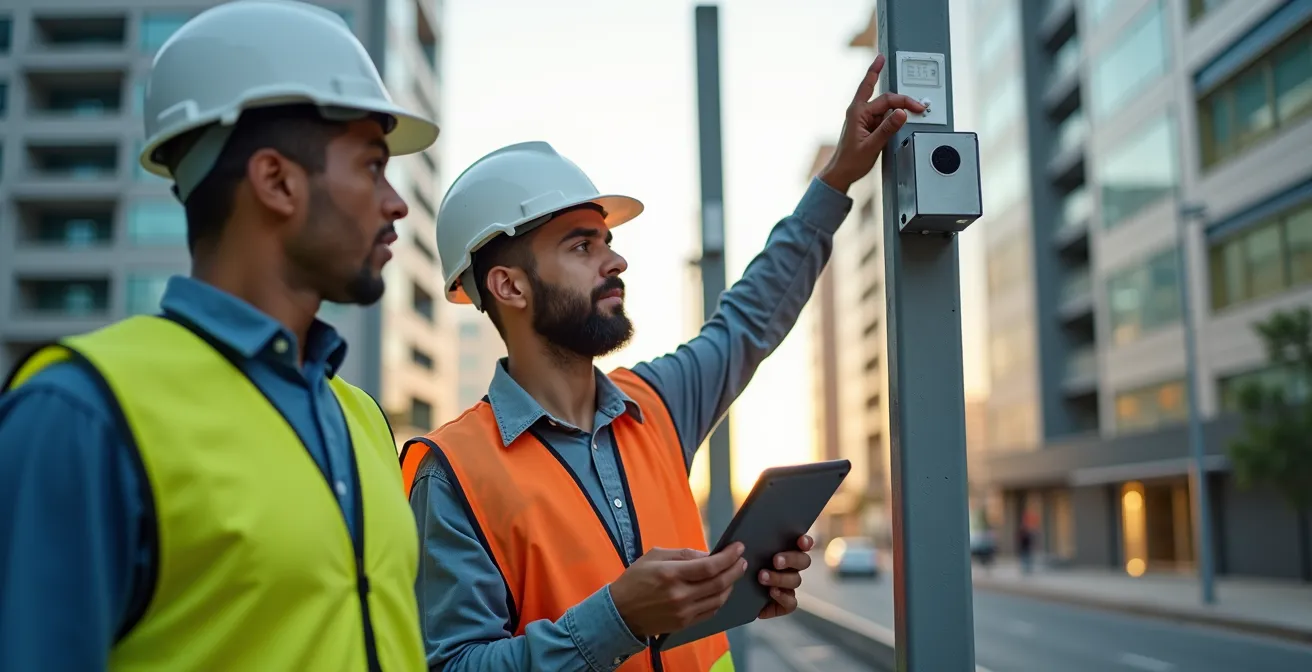
A sustainable maintenance program involves a dedicated team—or a contracted service provider—responsible for the entire technology stack. This includes everything from physical hardware cleaning and replacement to firmware updates, security patching, and network monitoring. By formalizing this function, the city transitions from a cycle of “deploy and forget” to one of “monitor, maintain, and modernize.” This ensures that the data streams powering your city’s efficiencies remain accurate, secure, and reliable, thereby protecting the foundational asset upon which your entire smart city ROI is built.
Ultimately, a city’s ability to realize the full potential of green technology rests on this foundation of fiscal discipline. By budgeting for the entire asset lifecycle, from procurement to decommissioning, you transform smart city technology from a speculative expense into a cornerstone of a more efficient, sustainable, and financially resilient municipality. The next logical step is to audit your current technology assets against this lifecycle framework.