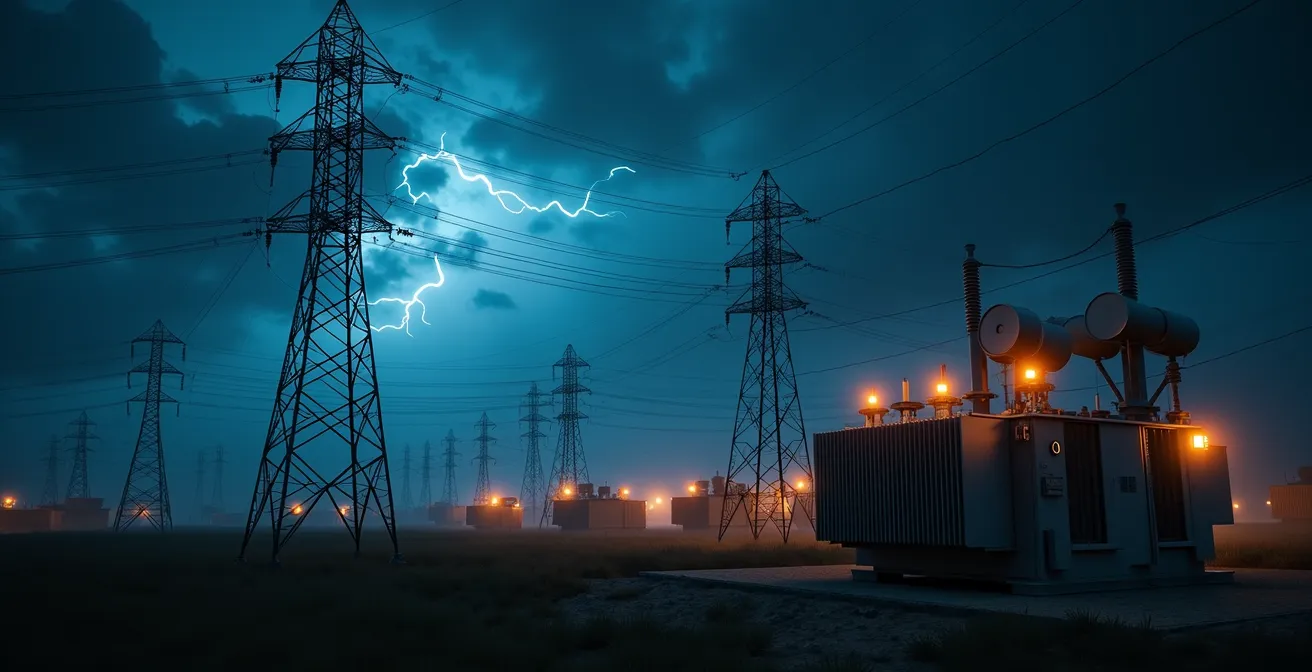
Preventing catastrophic, storm-induced blackouts is not about building an unbreakable grid, but a hyper-responsive one that surgically isolates failures in seconds.
- Modern grid defense relies on high-speed automation like FLISR to contain faults locally, preventing them from triggering a domino effect across the network.
- True resilience is an ecosystem of technologies, combining predictive maintenance, dynamic load balancing (V2G, VVO), and solutions to the growing grid inertia problem.
Recommendation: Grid operators must shift from a reactive recovery model to a proactive defense strategy that integrates predictive analytics and automated, sub-second response capabilities across all infrastructure layers.
When a severe storm hits, the initial damage to a power line or substation is often inevitable. The real catastrophe, however, isn’t the localized outage; it’s the subsequent, uncontrolled chain reaction. A single fault can overload adjacent lines, causing them to trip, which in turn places unsustainable strain on the next part of the system. This is a cascading failure, a domino effect that can plunge millions into darkness from a single point of failure. For decades, the response has been focused on manual restoration—a slow, resource-intensive process.
The common discourse around smart grids often centers on abstract benefits like “efficiency” and “reliability.” While true, these terms fail to capture the profound strategic shift required to defend against cascading collapses. The solution is not merely about faster repairs but about building an intelligent, self-healing ecosystem. This system must be capable of sensing, analyzing, and acting in microseconds to contain threats before they escalate. It requires a fundamental move away from passive infrastructure towards an active, dynamic defense network.
But what does this defensive ecosystem truly entail? The key lies in a layered strategy that combines automated fault isolation, dynamic load balancing, and a deep understanding of the new physics governing a renewable-heavy grid. It’s about deploying technologies that can surgically sever a failing section, reroute power instantly, and even use electric vehicles as a distributed battery to stabilize the entire network. This article will deconstruct the core components of this modern grid defense, providing a strategic roadmap for operators and planners to build a system that doesn’t just recover from storms, but actively withstands them.
This in-depth analysis will cover the critical technologies and strategies that form the pillars of a resilient power grid. From automated restoration systems to the challenges of grid inertia, we will explore the mechanisms that keep the power on when it matters most.
Table of Contents: A Framework for Preventing Cascading Grid Failures
- Why FLISR Technology Restores Power in Seconds Instead of Hours?
- How to Isolate a Microgrid to Keep Hospitals Running When the Main Grid Fails?
- EV Batteries as Backup: Using Vehicle-to-Grid (V2G) to Stabilize the Network
- The Grid Attack Risk: Protecting Substations from State-Sponsored Hacking
- When to Upgrade Transformers: Using Data to Predict Overload Before It Explodes?
- How to Use Volt-VAR Optimization to Flatten the Consumption Curve?
- The Inertia Problem: Why Removing Rotating Generators Destabilizes the Grid
- Solving Intermittency: How to Keep the Lights On When the Wind Stops Blowing?
Why FLISR Technology Restores Power in Seconds Instead of Hours?
In a traditional grid, a fault—like a tree falling on a power line during a storm—triggers a lengthy manual process. Engineers must identify the fault’s location, dispatch a crew to physically isolate the damaged section, and then manually reroute power. This can take hours, if not days. Fault Location, Isolation, and Service Restoration (FLISR) technology automates this entire sequence, reducing restoration time to mere seconds. It acts as the grid’s autonomic nervous system, containing damage before it can propagate.
The mechanism is a high-speed “sense, decide, and act” loop. Smart sensors and automated switches installed throughout the distribution network constantly monitor power flow. When a fault is detected, the system’s logic instantly triangulates the location. It then automatically opens switches on either side of the fault, surgically isolating the problem area. Immediately after, it closes other switches to reroute power from alternate feeders to as many customers downstream of the fault as possible. This entire operation is completed without human intervention, dramatically improving grid resilience. A 2014 Department of Energy study on FLISR implementation found it led to a 45% reduction in customers interrupted and a 51% reduction in total customer minutes of interruption.
However, not all FLISR architectures are created equal. As analysis from Schweitzer Engineering Laboratories (SEL) shows, a decentralized FLISR system using peer-to-peer communication is significantly faster. In this model, local controllers make immediate decisions, restoring power in seconds. In contrast, centralized systems must poll multiple devices and send data back to a central control room, introducing critical latency. For preventing a cascading failure, where every second counts, high-speed, decentralized automation is the superior defensive strategy.
How to Isolate a Microgrid to Keep Hospitals Running When the Main Grid Fails?
While FLISR restores power to the broader network, certain critical facilities like hospitals, data centers, and military bases cannot afford even a few seconds of downtime. This is where microgrids provide an essential layer of defense. A microgrid is a localized group of electricity sources and loads that can disconnect from the traditional grid and operate autonomously in “island mode.” During a widespread blackout, a microgrid can create a bubble of stable power, ensuring continuity for life-sustaining operations.
The key to this capability is the automated Point of Common Coupling (PCC) switch. This switch is the gateway between the microgrid and the main utility grid. When it detects a disturbance or complete failure on the main grid, it automatically opens, physically and electrically isolating the microgrid. At that moment, grid-forming inverters within the microgrid take over. These advanced inverters are crucial for a “black start,” as they have the ability to generate their own stable frequency and voltage reference, effectively creating a new, independent grid from scratch to power the facility’s internal loads.
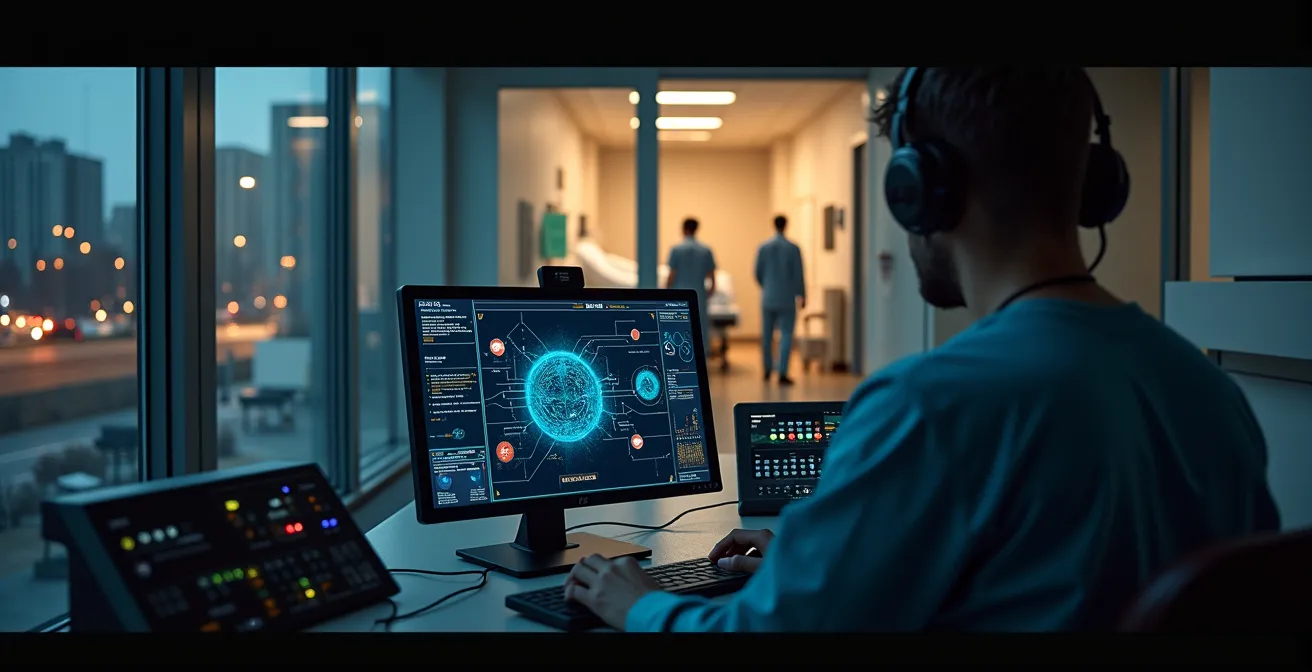
As this visualization shows, the microgrid becomes an island of light in a sea of darkness. For emergency planners, implementing a robust islanding strategy is not just about installing generation and storage; it’s about engineering the automation and control systems that can execute this transition seamlessly and reliably. Regular testing of these islanding scenarios is critical to ensure the system performs as designed during a real-world crisis.
Action Plan: Implementing a Resilient Microgrid Islanding Strategy
- Deploy closed-loop FLISR systems for critical facilities requiring uninterruptible power, enabling restoration in as fast as 8 cycles.
- Implement automated Point of Common Coupling (PCC) switches that can detect main grid failures and initiate islanding.
- Configure grid-forming inverters to establish stable frequency and voltage references for reliable black start conditions.
- Establish multi-source network configurations for campus environments and military bases to provide redundant power pathways.
- Conduct regular tests of islanding scenarios using distribution operations training simulators (DOTS) to validate performance and train operators.
EV Batteries as Backup: Using Vehicle-to-Grid (V2G) to Stabilize the Network
Traditionally, grid stabilization has relied on large, centralized power plants. However, the proliferation of electric vehicles (EVs) introduces a revolutionary new asset: a massive, distributed network of mobile batteries. Vehicle-to-Grid (V2G) technology transforms EVs from passive loads into active participants in grid defense. Instead of just drawing power, bidirectional chargers allow EVs to discharge stored energy back into the grid during times of stress, helping to stabilize frequency and prevent blackouts.
The potential scale is immense. With over 103 million US homes and businesses equipped with smart meters, the foundational communication infrastructure for coordinating these distributed assets is largely in place. During a major storm event where generation or transmission lines are compromised, a fleet of V2G-enabled vehicles can be aggregated into a Virtual Power Plant (VPP). This VPP can inject precisely controlled bursts of power to counteract sudden drops in frequency, providing critical support in the seconds before backup generators can spin up. This service is far more dynamic than simple V2H (Vehicle-to-Home) backup, as it actively supports the entire network.
Implementing true V2G requires specific hardware and communication standards. The following table breaks down the different levels of vehicle-grid integration, from basic smart charging to full grid stabilization services, highlighting the progression in capability and requirements.
| Technology Level | Hardware Requirements | Communication Standard | Grid Services |
|---|---|---|---|
| V1G (Smart Charging) | Standard charger | Basic scheduling | Load management only |
| V2H/V2B | Bidirectional charger | Local control | Building backup power |
| True V2G | Bidirectional charger | ISO 15118 Plug & Charge | Grid stabilization, frequency regulation |
| VPP Aggregation | Fleet management system | Advanced DERMS | Massive dispatchable battery |
The Grid Attack Risk: Protecting Substations from State-Sponsored Hacking
While storms pose a significant physical threat, a sophisticated cyberattack represents an equally, if not more, dangerous vector for triggering a cascading blackout. State-sponsored hacking groups can target the Supervisory Control and Data Acquisition (SCADA) systems that form the digital brain of the grid. By compromising these control systems, an attacker could simultaneously trip multiple breakers, manipulate voltage levels, or disable protective relays, creating a man-made “storm” of faults designed to cause maximum instability.
The threat is not theoretical. As the National Academies of Sciences, Engineering, and Medicine state in their report on grid resilience, the consequences are severe. A successful attack can go far beyond a service disruption.
A compromise of the power grid control system or other portions of the grid cyber infrastructure itself can have serious consequences ranging from a simple disruption of service to permanent damage to hardware that can have long-lasting effects on the performance of the system.
– National Academies of Sciences, Engineering, and Medicine, Enhancing the Resilience of the Nation’s Electricity System
Defending against such threats requires a multi-layered, “defense-in-depth” strategy that extends beyond software firewalls. A critical component of modern grid cybersecurity is the physical protection of data flows, particularly at critical substations.
Case Study: Physical-Cyber Security with Unidirectional Gateways
The National Academies report highlights that robust grid defense must secure both the digital and physical supply chains. One of the most effective advanced measures is the use of unidirectional security gateways, or “data diodes.” These are hardware devices that enforce a one-way flow of information. They allow monitoring data (like sensor readings and equipment status) to flow out of the secure control network to corporate networks for analysis, but they make it physically impossible for any data or commands to flow back in. This approach effectively creates an “air gap” that protects the core operational technology from remote attacks, while still allowing for essential system monitoring.
When to Upgrade Transformers: Using Data to Predict Overload Before It Explodes?
Transformers are the workhorses of the electrical grid, but they are also a critical vulnerability. An aging, overloaded transformer can fail catastrophically, causing a localized explosion and a significant outage. During a storm, load patterns shift unpredictably as parts of the grid go offline, placing unprecedented stress on the remaining transformers. A traditional “run-to-failure” or time-based maintenance schedule is insufficient to prevent these dynamic failures. The modern approach is to use data-driven predictive maintenance.
This strategy involves deploying an array of sensors to monitor a transformer’s vital signs in real time. These include thermal sensors to track winding temperatures, acoustic sensors to detect abnormal vibrations indicative of internal arcing, and dissolved gas analysis (DGA) sensors to monitor the chemical composition of the insulating oil for signs of degradation. This continuous stream of data is fed into AI-powered analytics platforms that can identify subtle patterns preceding a failure, often weeks or months in advance. This allows operators to schedule maintenance or an upgrade before a catastrophic event occurs.
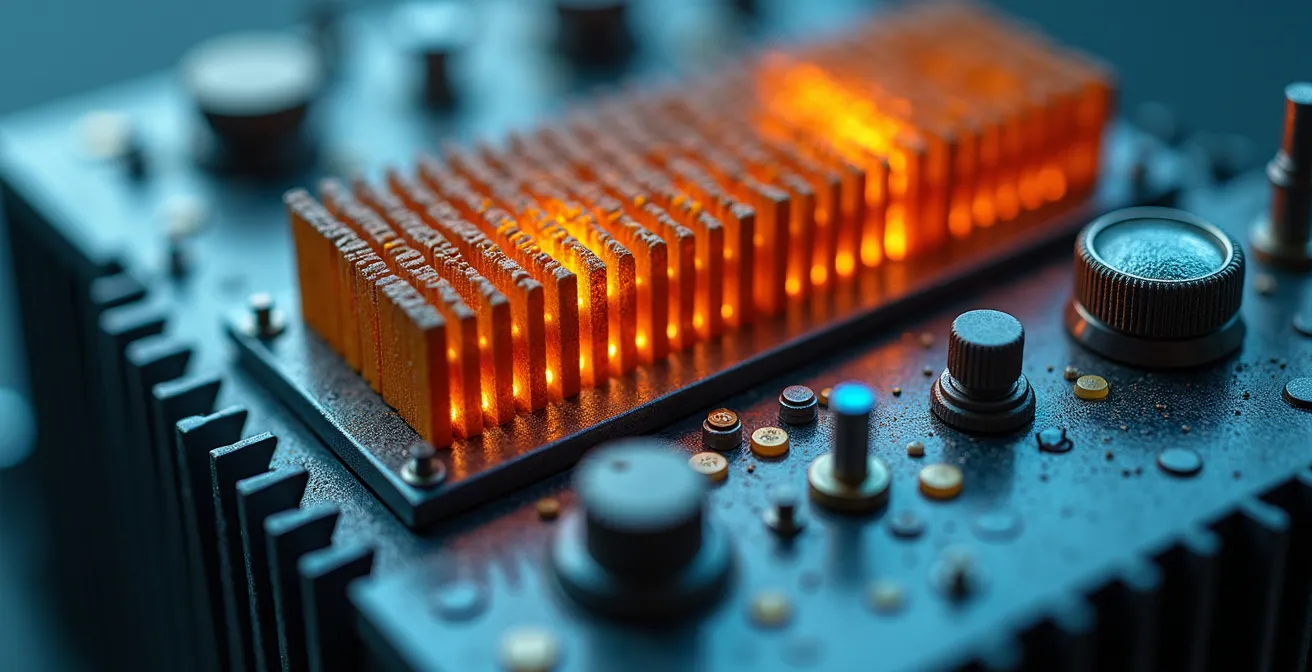
This shift from reactive to predictive asset management is not only safer but also more cost-effective. Research from the University of New Orleans Power and Energy Research Laboratory demonstrates that new AI-powered systems can be deployed for as little as $50 per monitoring point, a 60-80% cost reduction compared to conventional smart meters. This makes it economically viable to deploy predictive monitoring across a vast fleet of assets, hardening the grid against one of the primary triggers of cascading failures.
How to Use Volt-VAR Optimization to Flatten the Consumption Curve?
One of the most powerful yet subtle tools for preventing cascading failures is Volt-VAR Optimization (VVO). This strategy is about actively managing two key parameters on the grid: voltage and reactive power. While voltage is what drives the flow of “real” power that runs equipment, reactive power is essential for maintaining the electromagnetic fields in motors and transformers. Imbalances in reactive power can lead to voltage instability and, in extreme cases, voltage collapse—a primary mechanism in many large-scale blackouts.
The 2003 Northeast blackout, which affected 50 million people, serves as a stark case study. An analysis in Scientific American shows that a critical factor was the lack of sufficient reactive power to support voltage levels in Ohio after a few key lines tripped. The system couldn’t cope, and the voltage collapse cascaded across the region in minutes. Modern VVO systems provide a defense against this scenario. By using smart inverters, capacitors, and voltage regulators, a VVO system can dynamically inject or absorb reactive power to stabilize voltage across the network.
Furthermore, VVO enables a powerful defensive tactic known as Conservation Voltage Reduction (CVR). By intentionally and precisely lowering the voltage across non-critical circuits by a few percent (e.g., 3-5%), a utility can instantly shed a significant amount of load without causing a full outage. This is essentially a controlled, surgical “brownout” that reduces overall strain on the system during an emergency, freeing up capacity and preventing overloads on critical components like transformers. Key configurations for this include:
- Configuring smart inverters on distributed solar to provide dynamic reactive power support.
- Setting VVO systems to monitor and respond to rapid voltage swings, such as those caused by cloud cover over a large solar farm.
- Implementing fast-response algorithms that adjust within seconds, not minutes.
- Establishing voltage thresholds that trigger automatic Conservation Voltage Reduction.
- Deploying Phasor Measurement Units (PMUs) for high-fidelity grid data, capturing 30-60 measurements per second.
Key Takeaways
- Speed is paramount: The difference between resilience and collapse is measured in seconds. Technologies like decentralized FLISR and Fast Frequency Response are non-negotiable for containing faults.
- Defense is layered: A robust strategy requires a combination of surgical fault isolation (Microgrids), dynamic network balancing (V2G, VVO), and predictive asset health monitoring (AI).
- The grid’s physics is changing: The decline in mechanical inertia from retiring thermal plants must be actively compensated for with synthetic inertia from grid-forming inverters and battery storage systems.
The Inertia Problem: Why Removing Rotating Generators Destabilizes the Grid
As the grid transitions to renewable energy sources like wind and solar, a hidden and dangerous vulnerability emerges: the loss of grid inertia. For a century, our power grid has relied on the immense physical mass of spinning turbines in coal, gas, and nuclear power plants. Like a massive flywheel, the collective rotational energy of these generators provides inertia, which inherently resists changes in system frequency. If a large power plant suddenly trips offline, this inertia gives grid operators precious seconds to respond before the frequency collapses.
Renewable energy sources like solar and wind are connected to the grid through inverters, which have no moving parts and therefore provide zero natural inertia. As conventional plants are retired, the grid’s “cushion” disappears. With low inertia, the Rate of Change of Frequency (RoCoF) after a fault becomes incredibly steep, potentially leading to a system-wide collapse in under a second. This is a growing concern in regions with high renewable penetration. For instance, according to European electricity statistics, renewables accounted for 39% of EU electricity in 2020, a trend that continuously reduces system inertia.
A major blackout on the Iberian Peninsula demonstrated this crisis in stark reality. When a fault caused a loss of 15 GW (nearly 60% of supply) in just five seconds, the system was saved by the mechanical inertia of hydropower plants, which were able to respond and stabilize the grid. This event highlighted a critical truth: inertia is no longer a free property of the grid but a paid ancillary service. The solution lies in creating synthetic inertia using advanced grid-forming inverters on battery storage systems and solar farms. These inverters can be programmed to digitally simulate the behavior of a spinning generator, injecting power almost instantly to counteract frequency deviations.
Solving Intermittency: How to Keep the Lights On When the Wind Stops Blowing?
While synthetic inertia solves the problem of rapid frequency changes, the broader challenge with renewables is intermittency—the simple fact that the wind doesn’t always blow and the sun doesn’t always shine. Defending against a multi-day storm event, where solar and wind generation might be near zero, requires a strategy centered on long-duration energy storage (LDES). This goes beyond the capabilities of typical lithium-ion batteries, which are excellent for short-term frequency regulation but are generally limited to 2-4 hours of energy discharge.
Building a truly resilient, high-renewable grid means deploying a portfolio of storage technologies, each suited for a different timescale. This portfolio is the ultimate defense against prolonged generation shortfalls during extreme weather. As projects face interconnection queues, AI is stepping in. For example, analysis shows that Google and PJM’s AI-enhanced planning tools are shrinking interconnection timelines from over 40 months to a projected 1-2 years by 2026, accelerating the deployment of these critical assets.
The table below compares several leading LDES technologies, outlining their capabilities and best use cases for building a resilient, multi-day energy reserve. This diverse approach is essential for ensuring grid reliability around the clock, regardless of the weather.
| Storage Technology | Duration Capability | Response Time | Best Use Case |
|---|---|---|---|
| Lithium-ion Batteries | 2-4 hours | Milliseconds | Frequency regulation, peak shaving |
| Pumped Hydro | Days to weeks | Minutes | Seasonal storage, grid balancing |
| Compressed Air (CAES) | 8-24 hours | Minutes | Daily cycling, renewable integration |
| Green Hydrogen | Weeks to months | Minutes to hours | Long-term seasonal storage |
| Thermal Storage | 4-12 hours | Minutes | Building HVAC, industrial processes |
To build a truly resilient grid, operators and planners must move beyond siloed solutions and adopt an integrated, systems-level approach. The next step is to conduct a comprehensive audit of your network’s current capabilities against these advanced defensive layers to identify vulnerabilities and prioritize investments in high-speed, intelligent automation.