Your smart meter isn’t just measuring electricity; it’s building a high-resolution digital twin of your private life for sale.
- Electrical “signatures” allow utilities to know which specific appliances you use and when, inferring your daily routines.
- This granular data is often sold to data brokers, insurers, and marketers without your explicit, informed consent.
Recommendation: Protect yourself by understanding your legal opt-out rights, auditing your data, and challenging who has access to your consumption patterns.
Your home is your sanctuary, a private space where your life unfolds away from prying eyes. Yet, a device mandated by your utility company is quietly dismantling that privacy, one kilowatt at a time. The smart meter, sold as a tool for efficiency, has a far more lucrative, hidden function: conducting granular surveillance on your household. Most people believe it simply records total energy consumption. The reality is far more invasive. It’s capable of identifying when you brew coffee, watch a specific TV show, or leave for vacation. This isn’t a dystopian future; it’s the technical reality of Non-Intrusive Load Monitoring (NILM) technology embedded within these devices.
The common advice to “use strong passwords” or “be careful online” is dangerously insufficient here. The threat isn’t a hacker trying to get in; it’s the legally sanctioned, systematic collection and monetization of your most intimate data. This data exploitation chain begins with the unique electrical fingerprint of your appliances and ends in the hands of data brokers, insurers, and marketers who use it to build a “digital twin” of your life. This profile can influence your insurance premiums, the ads you see, and even your creditworthiness, all based on silent, invisible data collection.
But if you are the product, you are not powerless. The key is not to fight the technology but to dismantle the exploitation chain at every link. This requires a shift in perspective: from passive consumer to active privacy advocate for your own home. Instead of simply accepting the device, you must question the data it gathers, the vulnerabilities it creates, and the commercial ecosystem it feeds.
This article provides a protective and informative playbook to do just that. We will dissect the entire process, from how your electricity usage reveals your secrets to the backdoors in the technology. More importantly, we will equip you with the specific legal, technical, and procedural tools to refuse installation, audit your meter for inaccuracies, and exercise your rights to reclaim control over your personal data. It’s time to turn the lights back on and see exactly who is watching.
To navigate this complex issue, we have structured this guide to address each critical aspect of smart meter privacy. The following sections will provide a clear, step-by-step understanding of the risks and the concrete actions you can take to protect your household.
Summary: Unpacking the Privacy Risks of Smart Meter Data
- Why Your Electricity Usage Reveals What TV Show You Are Watching?
- How to Refuse a Smart Meter Installation Without Getting Fined?
- Zigbee Vulnerabilities: Is Your Smart Meter a Backdoor into Your Wi-Fi?
- The Data Broker Risk: Who Is Your Utility Company Selling Your Data To?
- How to Audit Your Smart Meter to Prove It Is Overcharging You?
- The Privacy Trap: What Happens When Smart Cities Collect Too Much Data?
- Why Metadata Reveals Your Secrets Even When Messages Are Encrypted?
- Sensitive Data Discovery: How to Find PII Hidden in Your Unstructured Files?
Why Your Electricity Usage Reveals What TV Show You Are Watching?
The core of the smart meter privacy threat lies in a technology called Non-Intrusive Load Monitoring (NILM). It doesn’t just see a lump sum of energy usage; it analyzes the high-frequency “noise” and patterns on your home’s power lines. Every appliance, from your refrigerator to your television, has a unique electrical signature or “fingerprint.” The compressor in your fridge creates a different pattern than the heating element in your kettle or the power supply in your specific model of TV. By disaggregating these signatures from the total energy load, the meter can determine which devices are running, for how long, and in what sequence. This isn’t a theoretical capability; it’s a proven method for granular profiling.

This detailed appliance data paints an astonishingly intimate picture of your life. It reveals your sleep schedule, when you cook, how often you do laundry, and even when you’re not home. Research has demonstrated just how powerful this re-identification can be. A groundbreaking study published in Nature Scientific Reports found that by knowing just five consecutive electrical measurements, it’s possible to re-identify on average more than 90% of households in a massive dataset. This is the raw material of surveillance capitalism, turning mundane energy data into a detailed, minute-by-minute diary of your private life, all without a single camera or microphone in your home.
The danger is not just that the utility company knows your habits. The danger is that this data is the first link in an exploitation chain. It’s collected, packaged, and prepared for analysis and sale. Understanding this initial step of appliance fingerprinting is the first critical milestone in recognizing the full scope of the privacy invasion and why protecting this raw data stream is paramount.
How to Refuse a Smart Meter Installation Without Getting Fined?
Knowing the risks, the most effective defense is to prevent the data collection at its source: by refusing the installation of a smart meter. While utility companies often present installation as mandatory, many jurisdictions provide legal “opt-out” procedures for concerned homeowners. This is your first and most powerful line of defense. However, exercising this right requires a formal, documented process and often comes with a financial cost. You are essentially paying a fee to protect your privacy from the very company you pay for electricity.
The process typically involves formally notifying your utility company, in writing, of your refusal. Vague phone calls are insufficient; a certified letter creates a legal paper trail. In this letter, you should clearly state your objections, whether they are based on privacy concerns, health worries about RF emissions, or security vulnerabilities. It’s also wise to research your specific state or local public utility commission (PUC) regulations, as they define the exact rules, fees, and procedures for opting out. In some cases, organizing with neighbors can create collective bargaining power, pressuring utilities to offer more reasonable opt-out programs.
While an opt-out program protects your privacy, it isn’t free. Utilities typically charge a one-time setup fee and a recurring monthly fee (often $10-$30) for the cost of having a meter reader manually check your older analog meter. This creates a difficult choice: pay a premium to protect your data or submit to surveillance for a lower bill. The following table breaks down this cost-benefit analysis.
| Factor | Opt-Out Cost | Privacy Risk Cost |
|---|---|---|
| Monthly Fee | $10-30 | N/A |
| Annual Total | $120-360 | Potential data breach liability |
| 10-Year Impact | $1,200-3,600 | Insurance premium increases, targeted marketing losses |
| Control Level | Full data control | Limited control over third-party sharing |
Ultimately, the decision to opt out is a personal one, weighing a concrete financial cost against an abstract but significant privacy risk. For those deeply concerned about granular profiling and the creation of a digital twin, this recurring fee is the price of digital freedom in your own home.
Zigbee Vulnerabilities: Is Your Smart Meter a Backdoor into Your Wi-Fi?
If a smart meter is installed, the privacy risk shifts from simple collection to insecure transmission. Smart meters don’t typically connect directly to your home Wi-Fi. Instead, they often use low-power wireless protocols like Zigbee or Z-Wave to form a “mesh network” with other meters in your neighborhood. This network communicates with a local data collector, which then sends the information back to the utility. While this setup avoids using your internet bandwidth, it introduces its own set of significant security flaws.
A primary vulnerability is a lack of encryption. As security experts reported in 2024 that many smart meters do not encrypt their data in transit, making it vulnerable to interception. Anyone with the right radio equipment and technical knowledge in proximity can potentially “sniff” the data being broadcast from your meter, capturing the same granular usage patterns that reveal your in-home activities. This is not a complex, state-sponsored attack; it’s a risk that can be exploited by tech-savvy criminals, stalkers, or overly curious neighbors. The meter becomes a constant, unsecured broadcast of your private life.
The consequences of these vulnerabilities are not just theoretical. They have led to real-world financial damage. The following case study highlights how security weaknesses can be exploited for more than just surveillance.
Case Study: The Puerto Rico Smart Meter Billing Fraud
A significant billing fraud incident in Puerto Rico demonstrated the tangible financial risks of insecure smart meter systems. Attackers were able to physically tamper with and reprogram meters to under-report electricity usage for certain customers, in exchange for payments. This led to substantial financial losses for the utility and underscored the critical need for both digital and physical security. While this attack was for financial gain, it proved that the meters’ systems were penetrable, opening the door for other malicious activities, including data interception and manipulation.
This incident, focused on billing, is a stark reminder that any security weakness can be a vector for multiple types of attacks. A system vulnerable to billing fraud is also a system vulnerable to data interception. Your smart meter, if not properly secured, can act as a backdoor, not necessarily into your Wi-Fi, but into the intimate data stream of your household’s daily life.
The Data Broker Risk: Who Is Your Utility Company Selling Your Data To?
The most alarming link in the data exploitation chain is monetization. Your utility company is sitting on a goldmine of behavioral data, and they know it. While you see electricity as a commodity you purchase, many utilities increasingly see your data as a far more valuable asset to be sold. This data is highly sought after by a vast and opaque industry of data brokers, insurance companies, and marketing firms.
As one privacy advocacy group bluntly stated, the value of this information can be immense. The Smart Meter Education Network highlighted this chilling reality in one of their reports:
The utilities themselves have said that the data they gather on you is worth more than the electricity they sell you.
– Smart Meter Education Network, DTE Smart Meter Privacy Report
This data is valuable because it allows for hyper-targeted advertising and risk assessment. An insurance company could raise your premiums if your data suggests a high-risk lifestyle. A marketing company could target you with ads for sleep aids if your meter indicates restless nights. This happens without your knowledge or explicit consent, often buried in the fine print of a privacy policy you never read. The “anonymization” of data is a flimsy shield; as we’ve seen, consumption patterns are so unique they can easily be re-identified.
Consumers are becoming increasingly wary of this invasive practice. Their concern is not unfounded and is backed by significant polling data. For instance, IEEE Spectrum Magazine reports that of more than 9,000 consumers polled across 17 countries, about one-third expressed that they would be discouraged from using energy-management programs if it meant giving utilities greater access to their data. This shows a growing public awareness and distrust of how this information is handled. The data broker risk transforms your utility provider from a simple service company into a potential node in the vast surveillance economy.
How to Audit Your Smart Meter to Prove It Is Overcharging You?
Beyond privacy invasion, smart meters have also been plagued by accusations of inaccuracy and overcharging. Many homeowners have reported sudden, unexplainable spikes in their electricity bills following a smart meter installation. While utility companies often dismiss these claims as being related to changing habits or weather, you have the right and the ability to conduct your own independent audit to verify your meter’s accuracy. This process empowers you to gather evidence and formally challenge your utility if you find discrepancies.
The key is to create a parallel record of your energy consumption using a trusted, consumer-grade energy monitor. Devices like the Sense Energy Monitor or the Emporia Vue are installed directly in your home’s electrical panel and use the same NILM technology to provide a highly accurate, real-time breakdown of your energy usage. By running one of these monitors for at least a month, you can establish an independent baseline to compare against your utility’s official readings.
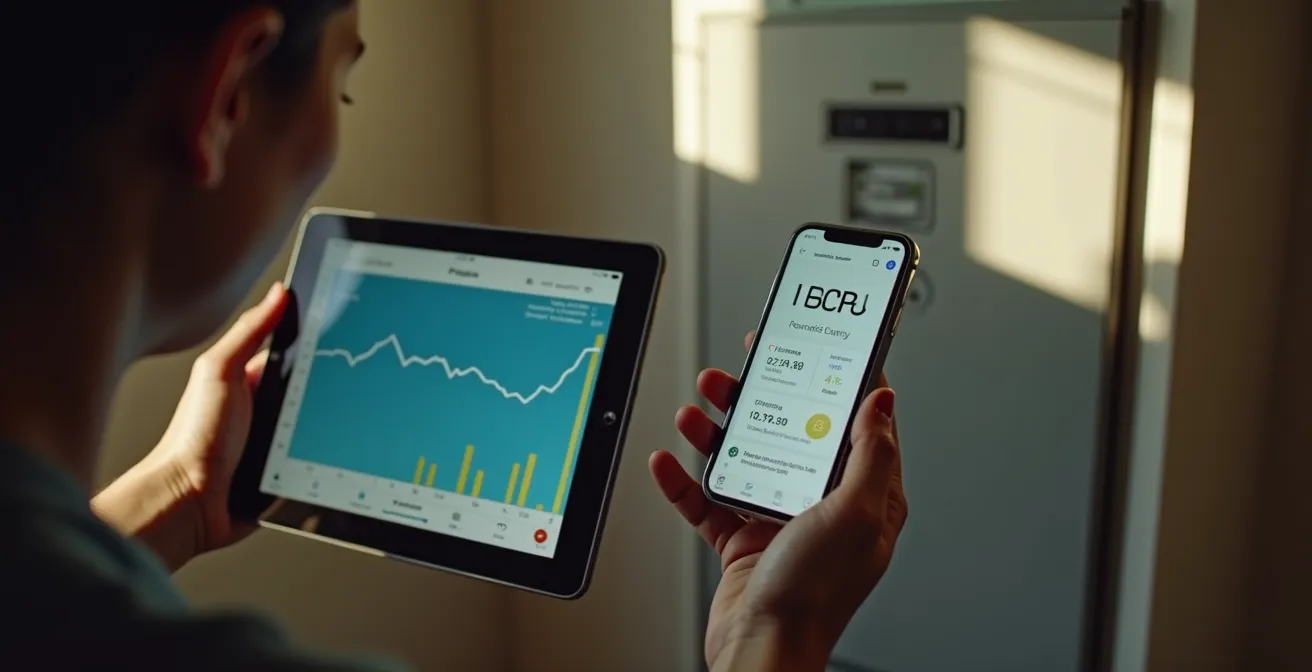
If your audit reveals a consistent pattern where the utility’s smart meter records significantly higher consumption than your independent monitor, you have a strong basis for a formal complaint. Document everything meticulously: save your utility bills, take screenshots of your energy monitor’s data, and note any specific dates or times with major discrepancies. This evidence-based approach is far more effective than simply calling customer service to complain. With a documented case, you can escalate the issue to your state’s Public Utilities Commission (PUC) or equivalent regulatory body.
Action Plan: Your DIY Smart Meter Accuracy Audit
- Install a Parallel Monitor: Purchase and install a consumer-grade energy monitor (like Sense or Emporia Vue) at your main circuit breaker panel to get an independent data source.
- Collect Baseline Data: Let the monitor run and record your household’s energy consumption for at least one full billing cycle (30 days) to establish a reliable baseline.
- Compare and Contrast: Carefully compare the total kWh recorded by your independent monitor with the total kWh listed on your official utility bill for the same period.
- Document Discrepancies: If you find discrepancies, document them with timestamps, comparative graphs, and screenshots. Note any patterns of overcharging (e.g., specific times of day, certain days of the week).
- File a Formal Complaint: Armed with your documented evidence, file a formal complaint with your utility company and, if necessary, escalate it to your state’s Public Utilities Commission (PUC).
The Privacy Trap: What Happens When Smart Cities Collect Too Much Data?
The privacy risks of smart meters extend far beyond your individual home, scaling up to the level of entire communities in the vision of a “smart city.” In this model, data from smart meters is aggregated with information from traffic sensors, public cameras, and other connected infrastructure to manage urban resources. While the goal is efficiency, the result is a pervasive web of surveillance that can create a detailed profile of the entire populace. The same granular data that reveals your morning coffee routine can, when combined with other data streams, track the movements and behaviors of a whole neighborhood.
This large-scale data collection raises profound legal and ethical questions, particularly concerning the right to privacy in one’s own home. In the United States, the Fourth Amendment protects against unreasonable searches. The landmark Supreme Court case Kyllo v. United States established a crucial precedent. In that case, the court ruled that using a thermal imager to scan the inside of a home from the outside constituted a search and required a warrant, because the technology was not in “general public use.”
This precedent is now being tested by smart meters. As a case study from Duke University’s Bass Connections program highlights, the detailed information from smart meters could be seen as a similar form of technological intrusion, granting consumers a reasonable expectation of privacy. However, there’s a catch: as these meters become ubiquitous, they may be legally reclassified as being in “general public use,” potentially eroding the very privacy protections established in Kyllo. The scale of deployment is massive; according to 2024 deployment statistics, over 200 million smart meters are already active in the European Union alone, covering more than 90% of households in countries like France. As this technology becomes the norm, the legal argument for privacy could paradoxically weaken, creating a “privacy trap” where mass adoption legitimizes mass surveillance.
Why Metadata Reveals Your Secrets Even When Messages Are Encrypted?
One of the most misleading arguments in favor of smart meters is that the data is “anonymized” or “encrypted.” This provides a false sense of security. Even if your personal name is detached from your energy readings, the metadata—the patterns of consumption—is so unique that it acts as a durable fingerprint. This is the classic lesson of metadata: you don’t need to know the content of a phone call if you know who called whom, at what time, and for how long. The context reveals everything.
Similarly, smart meter metadata reveals the rhythm of your life. It shows patterns of activity and inactivity that correspond to your work schedule, your sleep cycle, and your social life. As the European Data Protection Supervisor warned in a formal report, the potential for data mining from this metadata is enormous, allowing entities to track household activities with startling precision.
Smart meters will allow utilities and others to track what members of a household do within the privacy of their own homes… The potential for extensive data mining is very significant.
– European Data Protection Supervisor, European Parliament Office Report
The power of this metadata is not just theoretical. Studies have demonstrated exactly what can be inferred using NILM algorithms on smart meter data. It goes far beyond simple presence detection. A detailed case study showed how algorithms can successfully identify specific, intimate events. Based on the analysis of smart meter metadata alone, it was possible to obtain information about appliance usage (like air conditioners and dishwashers) and, more disturbingly, to infer events and behaviors. The research confirms that, using this data, it’s possible to identify when a household is having breakfast, lunch, dinner, parties, showering, and playing video games. Your “encrypted” and “anonymized” data stream becomes a detailed behavioral log, proving that metadata is not a secondary concern; it is the primary threat to your privacy.
Key Takeaways
- Your smart meter’s primary privacy risk is Non-Intrusive Load Monitoring (NILM), which identifies individual appliance usage.
- You often have a legal right to “opt-out” of smart meter installation, though it may involve monthly fees.
- Data from smart meters is a valuable commodity sold to data brokers, insurers, and marketers, creating your “digital twin.”
Sensitive Data Discovery: How to Find PII Hidden in Your Your Unstructured Files?
With such a vast amount of sensitive data being collected, the final line of defense lies in your legal rights as a data subject. Regulations like the General Data Protection Regulation (GDPR) in Europe and the California Consumer Privacy Act (CCPA) empower individuals to access, correct, and request the deletion of their personal data. These rights extend to the granular consumption data collected by your smart meter. You have the right to know what information your utility holds about you and, in many cases, to demand its removal.
Exercising these rights begins with a formal process known as a Data Subject Access Request (DSAR). This is a written request submitted to your utility company, formally asking for a copy of all the personal data they have collected about you, including historical energy consumption data at its most granular level. Utility companies may claim that the only personal information they hold is your name and address, but this is a narrow and often misleading interpretation. The consumption data itself, due to its ability to re-identify you, can be classified as Personally Identifiable Information (PII) under modern privacy laws.
Your rights don’t stop at access. You can also request the deletion of historical data that is no longer necessary for its original purpose (i.e., billing). While utilities must retain recent data for billing cycles, they often have no legal basis for keeping years of high-frequency consumption data for marketing or analytical purposes. A DSAR for deletion can force them to purge these extensive historical profiles, reducing your long-term privacy risk. While a 2022 UK Government report stated that smart meters represent a negligible cybersecurity risk compared to other smart devices, this misses the point. The primary threat isn’t a third-party hacker; it’s the routine, legal, and systematic exploitation of your data by the companies you are forced to do business with. Using a DSAR is your most direct tool to challenge this practice and reclaim ownership of your digital identity.
Protecting your household from granular profiling requires a proactive, multi-layered strategy. It is not about rejecting technology but about demanding accountability and control. By understanding the mechanisms of data collection, the vulnerabilities in the system, and your legal rights, you can effectively dismantle the surveillance apparatus one link at a time. The first step is to question what is happening behind the meter and take concrete action to secure your private life. Evaluate your situation, consult your local regulations, and decide on the best course of action to protect your home’s data sanctuary.
Frequently Asked Questions About Smart Meter Data and Privacy
Can I access all the smart meter data my utility has collected about me?
Yes, you generally have the right to access your smart meter data. This is often available through an in-home display or an online portal provided by your utility. Under regulations like GDPR and CCPA, your energy usage data belongs to you, and you can formally request a complete copy via a Data Subject Access Request (DSAR).
What type of personal information does a smart meter actually store?
Officially, utility companies state that a smart meter does not store or transmit personally identifiable information like your name, address, or bank details. The database primarily holds energy consumption readings. However, as this article explains, the granular nature of these readings can be used to create a behavioral profile so unique it can re-identify a household, making the consumption data itself sensitive personal information.
How can I request deletion of my historical smart meter data?
Under data privacy laws such as GDPR and CCPA, you can submit a formal Data Subject Access Request (DSAR) to your utility company. In this request, you can specifically ask for the deletion of historical consumption data that is no longer required for legitimate business purposes like billing. Utilities are generally obligated to comply with such requests for data that falls outside their necessary retention period.