
Successfully integrating renewables is not about picking one silver-bullet solution, but mastering a complex portfolio of operational trade-offs between physical grid realities and economic incentives.
- Energy storage solutions like batteries and pumped hydro have distinct scalability profiles and costs, making them suitable for different urban and geographical contexts.
- Grid stability depends on physical inertia, a property that inverter-based renewables lack, requiring new strategies like synthetic inertia and precise demand management.
Recommendation: Grid operators must shift from a mindset of passive energy acceptance to active system orchestration, leveraging AI, distributed resources, and economic signals to manage a dynamic, decentralized network.
The transition to renewable energy presents a fundamental paradox: the very sources that promise a clean future—wind and sun—are inherently variable. This challenge, known as intermittency, is often met with a familiar list of solutions: build more batteries, create smarter grids, and manage demand. While correct, these high-level answers obscure the complex operational realities and difficult trade-offs that grid operators and energy policy makers face daily. The core issue isn’t a lack of technological options, but a lack of clarity on how to deploy them cohesively and cost-effectively at a system-wide scale.
The conversation must evolve beyond simply naming technologies. We need to dissect the *how* and the *why*. For instance, stating that “energy storage” is the answer is insufficient. The real question is whether lithium-ion’s rapid deployment speed outweighs pumped hydro’s longevity and scale for a specific metropolitan area. Similarly, championing “smart grids” is meaningless without addressing the underlying physics of grid inertia, a critical stability factor that legacy power plants provided for free. The challenge isn’t just about generating green electrons; it’s about delivering them with the same unwavering reliability that has powered modern society for a century.
This analysis moves past the buzzwords to provide a realistic, solution-oriented framework. It is not a debate about whether to integrate renewables, but a technical deep-dive into the engineering and economic decisions required to make it a success. We will explore the granular trade-offs between different storage technologies, the practical application of AI in forecasting, the hidden dangers of lost inertia, and the economic logic of paying industries to power down. The goal is to equip decision-makers with the operational intelligence needed to build a grid that is not only clean but also resilient and reliable, ensuring the lights stay on, even when the wind stops blowing and the sun goes down.
To navigate these complex issues, this article is structured to address the most critical operational challenges and their respective solutions. The following sections break down each component of a modern, stable, and renewable-powered grid, offering a clear path from problem to practical implementation.
Summary: A Strategist’s Roadmap to Grid Stability
- Lithium-Ion vs Pumped Hydro: Which Storage Solution Scales for Cities?
- How to Use AI to Predict Solar Output 24 Hours in Advance?
- The Inertia Problem: Why Removing Rotating Generators Destabilizes the Grid
- The Curtailment Mistake: Throwing Away Free Wind Energy Because of Congestion
- How to Pay Factories to Shut Down During Peak Load?
- EV Batteries as Backup: Using Vehicle-to-Grid (V2G) to Stabilize the Network
- Why Smart Street Lighting Cuts Municipal Energy Bills by 40%?
- How to Isolate a Microgrid to Keep Hospitals Running When the Main Grid Fails?
Lithium-Ion vs Pumped Hydro: Which Storage Solution Scales for Cities?
Choosing the right energy storage is a foundational decision for grid stability, and the debate often centers on two titans: Lithium-Ion Battery Energy Storage Systems (BESS) and Pumped Hydro Storage (PHS). The choice is not about which is “better” but which is best suited for a specific environment, particularly dense urban centers. Lithium-ion batteries offer unparalleled flexibility and a small physical footprint, making them ideal for deployment in cities where space is a premium. Their modular nature allows for scalable installations, from small neighborhood substations to large, grid-scale facilities. While historically more expensive, their costs are falling rapidly, and their efficiency in short-duration storage (providing power for a few hours) is excellent.
Pumped hydro, by contrast, is a technology of massive scale and geographic dependency. It requires two large water reservoirs at different elevations, making it an impractical solution for most urban landscapes. However, where geography permits, it offers long-duration storage (10 hours or more) and a very long operational lifespan. The initial capital cost is significant, with figures ranging widely based on terrain and construction complexity. An analysis from the Electric Power Research Institute highlights this trade-off, showing that while PHS can be cheaper on a per-kilowatt basis in ideal conditions, the practical cost and land requirements are substantial. The current market trend, however, heavily favors batteries, with analysis suggesting that global lithium-ion capacity is set to overtake pumped hydro in 2025, driven by falling costs and rapid deployment.
The visual below contrasts the compact, modular nature of urban battery installations with the vast, geography-dependent scale of a pumped hydro system, illustrating the core trade-off between spatial efficiency and large-scale duration.

This stark difference in physical form dictates their application. For a city, a network of distributed BESS units provides surgical precision in managing local grid congestion and voltage, while a remote PHS plant acts more like a giant, slow-charging power bank for the entire region. The following table provides a clear comparison of their core performance metrics, showing how each technology is optimized for different roles within the grid ecosystem.
| Metric | Battery Storage | Pumped Hydro |
|---|---|---|
| Round-trip Efficiency | 82% | 79% |
| Typical Duration | 6 hours | 10 hours |
| US Capacity (2020) | 1.4 GW | 21.9 GW |
| Utilization Factor | Lower | 2x higher than batteries |
Ultimately, for urban grid planners, the solution is not an either/or choice but a portfolio approach. Lithium-ion batteries are the clear winners for immediate, localized urban scaling, while pumped hydro remains a valuable, long-duration asset where geography and regional planning align.
How to Use AI to Predict Solar Output 24 Hours in Advance?
The greatest challenge of solar and wind power is its variability. A grid requires perfect balance between supply and demand, yet renewable generation can swing dramatically. For example, solar and wind farms in Europe have been known to fluctuate from near zero to over 23GW and 24GW respectively, based on weather conditions. Historically, managing this was a reactive process. Today, Artificial Intelligence (AI) and machine learning are transforming forecasting from a best-guess estimate into a precise, data-driven science, allowing operators to predict solar output with remarkable accuracy up to 24 hours or more in advance.
AI models achieve this by synthesizing vast and diverse datasets far beyond simple weather reports. They analyze real-time satellite imagery to track cloud cover, speed, and density. They incorporate historical performance data from the solar farm itself, learning its unique characteristics and degradation patterns. Furthermore, they process atmospheric data like aerosol and water vapor levels, which can significantly impact solar irradiance. By cross-referencing these inputs, the AI can predict not just *if* it will be cloudy, but the *impact* of that specific cloud cover on a specific solar array at a specific time.
This predictive power is a game-changer for grid operations. Knowing with high confidence what solar generation will be tomorrow allows operators to proactively schedule other resources. They can determine precisely how much power to request from natural gas peaker plants, how much energy to store in or discharge from batteries, and when to execute demand-response programs. This proactive stance is a stark contrast to the traditional, reactive model. As noted by Robert Fares in Scientific American, the operational tempo of the grid is relentless. He explains:
Today, the grid operator sends a signal to power plants approximately every four seconds to ensure the total amount of power injected into the grid consistently equals the total power withdrawn
– Robert Fares, Scientific American – Renewable Energy Intermittency Explained
This high-frequency balancing act becomes infinitely more manageable with accurate forecasting. Instead of scrambling to react to a sudden drop in solar output, operators can have a contingency plan already in motion. The result is a more stable, efficient, and cost-effective grid, minimizing the reliance on expensive, fast-ramping fossil fuel reserves and maximizing the value of every green electron generated.
The integration of AI is not merely an incremental improvement; it is a fundamental shift that enables a much higher penetration of variable renewables without compromising the stability the system demands.
The Inertia Problem: Why Removing Rotating Generators Destabilizes the Grid
One of the most critical and least-understood challenges of the renewable transition is the loss of grid inertia. For a century, our power grid has relied on the physical property of inertia from massive, spinning turbines in conventional power plants (coal, gas, nuclear, hydro). These rotating masses act like giant flywheels, resisting changes in system frequency. When a large power plant or transmission line suddenly fails, this stored kinetic energy is automatically released, providing a buffer of a few crucial seconds that gives the grid operator time to bring backup power online. The core rule is that for there to be stability, energy generated must precisely equal energy consumed at every instant.
Solar panels and wind turbines, however, are connected to the grid through inverters. They have no large, rotating parts and therefore contribute zero physical inertia. As these inverter-based resources replace conventional generators, the grid becomes lighter, more brittle, and far more vulnerable to frequency fluctuations. A sudden fault that would have caused a minor, manageable dip in frequency on the old grid could now trigger a rapid, cascading blackout on a low-inertia grid. This “inertia problem” is a purely physical constraint that no amount of energy generation alone can solve; it requires a new approach to creating stability.
The solution lies in creating “synthetic inertia.” Modern, grid-forming inverters can be programmed to mimic the behavior of rotating generators. Using advanced controls and drawing from a connected energy source like a battery, they can inject or absorb power almost instantaneously to counteract frequency deviations. This digital response emulates the physical buffer that was lost. Alongside synthetic inertia, a portfolio of other technologies is essential for maintaining a stable, renewable-heavy grid. This includes deploying large-scale energy storage, implementing smart grid monitoring, and strategically building new transmission capacity to reduce bottlenecks.
Action plan: Key points for ensuring grid stability
- System Services: Deploy a mix of energy storage, including lithium-ion batteries and leveraging mobile EV batteries with V2G technology, to provide rapid frequency response.
- Transmission: Invest in virtual transmission (using battery systems to ease congestion) and build new High-Voltage Direct Current (HVDC) lines from generation hubs to load centers.
- Intelligence: Implement smart grids with real-time, intelligent monitoring to predict equipment failures and automate responses.
- Voltage Support: Install dedicated reactive power compensation plants to maintain stable voltage levels across the network, a service traditionally provided by conventional generators.
- Contingency: Develop strategies that combine the above elements to create a multi-layered defense against the loss of physical inertia and ensure system resilience.
Ignoring the inertia problem is akin to building a race car with a powerful engine but a fragile chassis. The system may appear to work under normal conditions, but it is destined to fail catastrophically under stress.
The Curtailment Mistake: Throwing Away Free Wind Energy Because of Congestion
Curtailment is a term for a seemingly nonsensical act: deliberately shutting down wind turbines or solar farms even when the wind is blowing or the sun is shining. This isn’t done because the energy isn’t needed, but most often because there is no physical way to get it from where it’s generated to where it’s consumed. The transmission lines are full. This phenomenon represents one of the greatest inefficiencies in the renewable transition, effectively throwing away clean, free fuel. The scale of this waste is staggering; at times, Australia’s National Energy Market curtailed nearly 40GWh of variable renewable energy (VRE) in a single day, equivalent to 20% of the native demand during that period.
The root cause is a mismatch in investment. We have accelerated the construction of new wind and solar farms, but the development of a corresponding high-voltage transmission grid has lagged decades behind. Renewable resources are often located in remote, windy or sunny areas, while demand is concentrated in cities hundreds of miles away. Without enough “highway lanes” for the electrons to travel, the grid experiences traffic jams, or grid congestion. When congestion occurs, the grid operator’s only option to prevent overloading lines and causing blackouts is to order the nearest generators—often the wind or solar farms—to stop producing.
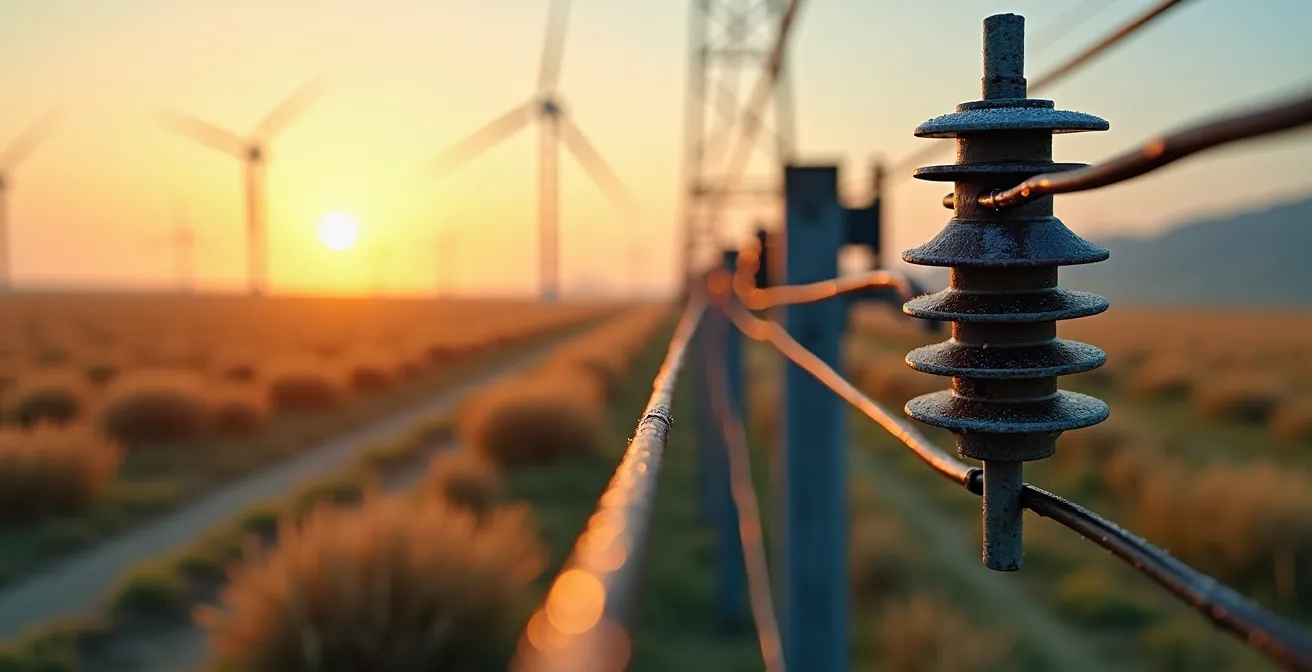
This image of transmission lines with wind turbines blurred in the background symbolizes the bottleneck: ample generation capacity that cannot reach its destination due to infrastructure limits.
Solving the curtailment mistake requires a two-pronged approach. The long-term, capital-intensive solution is to build more transmission lines—a process fraught with permitting delays and high costs. A faster, more innovative solution is the deployment of Grid-Enhancing Technologies (GETs). These are a suite of advanced hardware and software, such as dynamic line rating (which assesses a line’s true, real-time capacity based on weather) and advanced power flow controllers, that can optimize the performance of the existing grid. As a case in point, the U.S. Department of Energy is actively promoting GETs to modernize the system, helping to squeeze more capacity out of the infrastructure we already have and better integrate renewable sources without waiting a decade for new lines to be built.
By shifting focus from just building more generation to intelligently upgrading our energy delivery networks, we can stop throwing away clean energy and accelerate a truly efficient transition.
How to Pay Factories to Shut Down During Peak Load?
One of the most elegant and cost-effective tools for managing grid intermittency doesn’t involve building new power plants or batteries at all. It involves changing when we use electricity. This concept is called Demand Response (DR), a set of programs that financially incentivize large energy consumers, like factories, data centers, and commercial buildings, to temporarily reduce their electricity consumption during periods of peak demand or low renewable supply. Instead of firing up an expensive and polluting “peaker” plant to meet a spike in demand, the grid operator can simply pay a factory to pause a non-critical, energy-intensive process for an hour.
The mechanism works through clear economic signals. Utilities or grid operators establish contracts with industrial partners. When the grid is under stress—for instance, on a hot, still summer afternoon when air conditioning demand is high but wind generation is low—the operator sends a DR signal. The participating factory then curtails its load according to the agreement, perhaps by delaying a furnace cycle or shifting a production run. In return, the factory receives a significant payment, which is often far cheaper for the utility than the cost of generating emergency power. This turns large energy users from passive consumers into active, valuable partners in grid stability.
As the Green.org Energy Research Team states, the goal is to create a dynamic and flexible system. Their analysis highlights that “Demand response programs enable consumers to adjust their electricity consumption based on the availability of renewable energy.” This creates a symbiotic relationship: the grid gains a virtual power plant that can be dispatched instantly, while the consumer gains a new revenue stream. The key to successful DR programs is automation and precision. Modern systems use intelligent software that integrates with a factory’s control systems, allowing the load reduction to happen automatically and with minimal disruption to core operations. The factory can pre-define which loads are curtailable and under what conditions, ensuring that participation in a DR event never compromises productivity.
By treating demand not as a fixed, uncontrollable variable but as a flexible resource, operators can build a more resilient and efficient grid at a fraction of the cost of new infrastructure.
EV Batteries as Backup: Using Vehicle-to-Grid (V2G) to Stabilize the Network
The accelerating adoption of electric vehicles (EVs) represents not just a shift in transportation, but also the deployment of a massive, distributed energy storage network. Every EV contains a sophisticated battery that sits idle for the vast majority of the day. Vehicle-to-Grid (V2G) technology harnesses this untapped potential, enabling EVs to not only draw power from the grid but also discharge it back, acting as a network of small, mobile batteries that can help stabilize the entire system. When renewable energy is abundant, millions of EVs can charge, absorbing excess supply. When demand peaks or solar/wind generation drops, they can collectively inject power back into the grid, providing critical ancillary services like frequency regulation.
The economic logic is compelling. Building dedicated utility-scale battery storage is a capital-intensive process. While costs are decreasing, with the levelized cost of storage (LCOS) for utility-scale systems dropping, they are still significant. Highjoule’s 2024-2025 guide indicates that, as of 2024-2025, BESS costs for utility-scale systems range from $0.20-$0.35/kWh. V2G leverages assets that are already paid for by consumers, drastically lowering the barrier to entry for adding storage capacity. EV owners can be compensated for allowing their vehicles to participate in grid services, creating a new revenue stream that can offset the cost of ownership. This turns a personal vehicle into an active grid asset.
For V2G to function at scale, it requires a sophisticated smart grid infrastructure. It’s not as simple as just plugging in a car. The system needs to manage the flow of energy and information seamlessly. This is where intelligent energy management systems are crucial. As described in a study on grid integration, these systems “use real-time data analytics, AI, and machine learning to predict energy demand, optimise energy dispatch, and manage grid stability.” Smart grids provide the two-way communication necessary for a utility to signal to thousands or millions of EVs when to charge or discharge, aggregating their small individual capacities into a powerful, dispatchable virtual power plant. The EV’s software can be programmed with the owner’s preferences, ensuring the battery never drains below a certain level and is always ready for their daily commute.
V2G transforms the EV from a potential grid problem (high charging loads) into a fundamental part of the intermittency solution, creating a decentralized, resilient, and economically efficient storage network.
Why Smart Street Lighting Cuts Municipal Energy Bills by 40%?
At first glance, street lighting might seem like a minor component of the overall energy grid. However, for a municipality, it can represent up to 40% or more of its total electricity budget. The transition to “smart” street lighting is one of the most practical and high-impact applications of demand-side management. It goes far beyond simply swapping old sodium bulbs for energy-efficient LEDs. A smart lighting system creates an intelligent, responsive network that can be dynamically controlled to slash energy consumption, reduce operational costs, and even serve as a platform for other smart city applications.
The core of the system is connectivity. Each streetlight is equipped with a node that allows it to communicate with a central management system. This enables operators to remotely monitor every single light, receive instant alerts for outages, and, most importantly, implement dynamic dimming schedules. Instead of running at 100% brightness all night, lights on a quiet residential street can be dimmed to 30% after midnight and instantly brought back to full brightness when motion sensors detect a pedestrian or vehicle. This granular control is what drives the dramatic energy savings. It eliminates wasted electricity while maintaining safety and public perception of safety.
This level of control also makes smart lighting a valuable asset for broader grid stability, especially as renewable penetration increases. With last year low-carbon sources accounted for 56% of UK electricity (43% from renewables and 13% from nuclear), the need for flexible loads is paramount. A city’s entire network of streetlights can act as a dispatchable load in a demand response program. During a moment of grid stress, an operator could send a signal to universally dim all streetlights by a small, imperceptible amount (e.g., 10%), instantly shedding megawatts of load from the system. This capability, as part of a larger ecosystem of Distributed Energy Resources (DERs), adds another layer of flexibility for grid operators. It’s a prime example of how everyday infrastructure can be transformed into an active participant in solving intermittency.
Key takeaways
- Solving intermittency requires a portfolio of solutions, not a single technology, balancing storage, demand management, and grid intelligence.
- Physical grid constraints like inertia and transmission congestion are as important to solve as generation itself, requiring investment in both new hardware and smarter software.
- The most cost-effective solutions often involve leveraging existing or distributed assets—from factory loads to EV batteries—turning passive consumers into active grid participants.
Ultimately, smart street lighting is a powerful demonstration of how intelligent, demand-side management provides a clear, cost-effective, and highly impactful pathway to a more efficient and stable energy future.
How to Isolate a Microgrid to Keep Hospitals Running When the Main Grid Fails?
The ultimate test of grid resilience is its ability to protect critical infrastructure during a widespread power outage. Hospitals, emergency response centers, and data hubs cannot afford to go dark. The solution is the microgrid: a localized group of electricity sources and loads that can disconnect from the traditional grid and operate autonomously. This ability to “island” itself is what provides unparalleled resilience. A hospital with its own microgrid—typically comprising solar panels, battery storage, and a backup generator—can maintain uninterrupted power for its life-support systems and operating rooms, even if the surrounding city is blacked out for days.
The key to a microgrid’s function is its advanced control system. This “brain” constantly monitors the health of the main grid. The instant it detects a fault, such as a drop in voltage or frequency, it commands a high-speed switch to open, physically isolating the microgrid from the external network. Simultaneously, it orchestrates the internal Distributed Energy Resources (DERs). It might draw power from the batteries to cover the immediate load, then signal the solar panels to continue charging the batteries, all while keeping the backup generator in reserve. As a case study in resilience explains, “Microgrids operate independently or in conjunction with the main grid, providing a more resilient and flexible energy supply. They can quickly respond to local demand changes and provide backup power during outages.”
Beyond providing backup for a single facility, a network of microgrids also contributes to the stability of the main grid. By generating and storing power locally, they reduce stress on aging transmission and distribution infrastructure. Furthermore, the aggregation of numerous DERs within a region has a stabilizing effect on the predictability of renewable generation. A single solar array is highly variable, but the combined output of thousands of rooftop installations across a city is much smoother and easier to forecast. This is a practical application of a statistical principle: experts note that renewable energy actually becomes more predictable as the number of generators increases due to geographic diversity and the Law of Large Numbers. A cloud over one neighborhood doesn’t affect another, creating a more stable aggregate output.
By deploying microgrids for critical facilities, we are not just creating islands of safety; we are building a more decentralized, resilient, and inherently stable energy system from the ground up, capable of weathering the storms of an uncertain future.